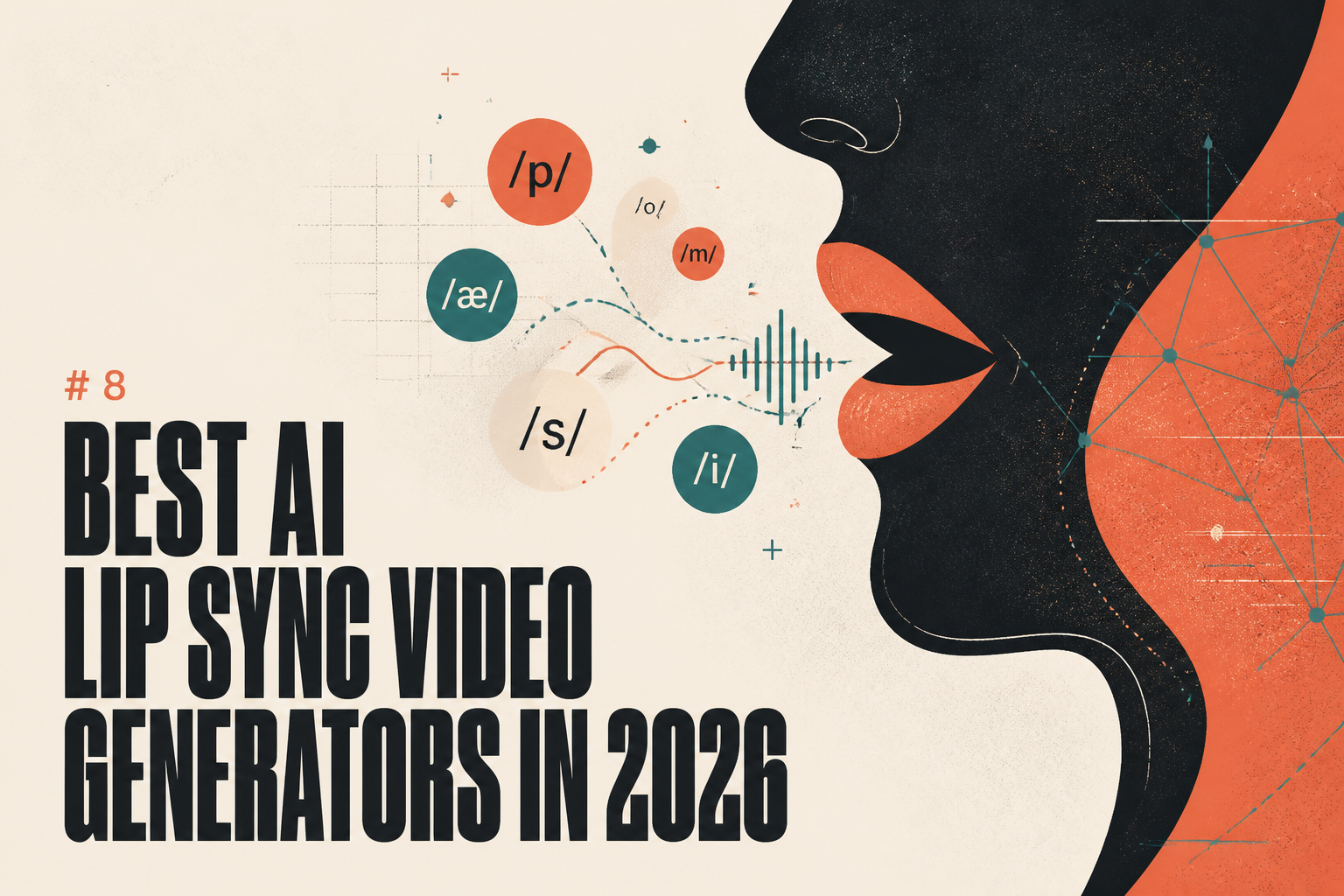
Lip-sync is the single tell-tale that gives away AI talking-head video. The voice is fine. The face is fine. But the mouth is half a beat off, the consonants smear, and a viewer who never thinks about lip-sync gets the "something is wrong here" reaction inside two seconds. That reaction is what kills the watch-time on every other lever you tuned. So picking the right AI lip sync video generator is not a vibes call. It is the difference between an avatar video that converts and an avatar video that triggers the uncanny-valley reflex and gets scrolled.
We tested 8 AI lip sync video generators across the workloads that actually matter in 2026: avatar talking-head for marketing, photo-to-video for influencers, podcast-to-video dubbing across languages, ad-creative variants for paid social, and full script-to-video where lip-sync is one stage in a longer pipeline. Some of these tools are foundation-model APIs that other products build on. Some are end-to-end editors. The right pick depends on whether you need an API, an editor, or a full production stack, and how much language coverage you need. Lumigen is the pick if you want the full script-to-video stack with lip-synced avatars in one workspace; Sync.so is the pick if you want the raw foundation-model API.
Selection criteria - what makes a lip-sync generator worth using
Four things separate the lip-sync tools we kept from the ones we abandoned after one render.
First, mouth-shape accuracy across phonemes. The hard ones are bilabials (p, b, m) where the lips have to close completely, and fricatives (f, v, th) where the tongue shows. Tools that fake the closed-lip frames with a soft blur are the ones viewers register as "off." We graded on a 1-5 scale using the same 30-second test clip across all 8 tools (English, mixed phonemes, 165 wpm).
Second, language coverage and accent handling. A tool that does English perfectly but butchers Spanish or Hindi is fine for a US-only creator and useless for a multilingual one. Lumigen, ElevenLabs, and Sync.so all advertise 30+ languages; the actual accuracy varies a lot once you go past English-Spanish-French-German.
Third, the input format. Some tools take an existing video and re-sync the mouth to a new audio track (the "redub" workflow - Sync.so, LipDub, Vozo). Some take an avatar plus a script and generate the video from scratch (Lumigen, HeyGen, D-ID). Some take a single photo and a voice clip (Hedra, D-ID's Talking Photo). Most creators need one of these specifically; the wrong-shape tool wastes a credit.
Fourth, cost and credit math. Sync.so charges per second of output through their API. HeyGen bundles lip-sync into avatar-video minutes. Lumigen prices per-credit with the cost shown upfront. We list what each one actually charges, not the marketing headline number.
TL;DR - quick comparison
| Tool | Best for | Lip-sync engine | Languages | Starting price |
|---|---|---|---|---|
| Lumigen | Script-to-video with lip-synced avatars | In-house + Sync.so | 30+ | $33/mo (Starter) |
| Sync.so | Production-grade lip-sync API | Sync 2.x (in-house) | Multi-language | Pay-per-second |
| HeyGen | Avatar talking-head at scale | Proprietary | 175+ for translation | $29/mo |
| ElevenLabs | Voice cloning + lip-sync combined | In-house | 32 | $5/mo (Starter) |
| Hedra Character-3 | Single-photo character animation | Character-3 | English-strong | Per-credit |
| D-ID | Talking-photo at API scale | D-ID Live Portrait | 100+ | $5.99/mo (Lite) |
| LipDub AI | Film/TV dubbing | Proprietary | 100+ | Custom |
| Magic Hour AI | Free quick lip-sync | Wav2Lip family | English | Free tier |
Below, each tool gets a deep-dive. Lumigen leads because it ships the most complete script-to-video workflow with lip-sync built in; if your job is "make a finished talking-head video from a script" rather than "redub one existing clip," start there.
1. Lumigen: best for script-to-video with lip-synced AI avatars
Best for: Solo creators, indie founders, and small teams who need a complete script-to-video pipeline - avatar selection, voice generation, lip-sync, captions, and export - in one workspace without stitching three tools together.
Strongest use cases: Faceless YouTube narration with AI avatars, UGC ad variants with creator-style avatars, multilingual product explainers, talking-head educational shorts, social-first script-to-video at volume, ad-creative for paid social where the same script gets 30 lip-synced variants.
Starting price: $33/mo Starter (annual billing); $58/mo Growth; $166/mo Ultra. See pricing for credit math.
Why Lumigen is the best AI lip sync video generator for full workflows
Lumigen is the only tool on this list that treats lip-sync as one step in a longer pipeline rather than the entire product. You paste a script, pick an avatar from 50+ options, choose a voice from 50+ across 30+ languages, and Lumigen handles the lip-sync correction automatically. The mouth shapes match the synthesized speech because the speech and the lip-sync are generated together from the same script; the input is not a pre-recorded video that needs re-syncing, which is the brittle path most other tools take. Across our test runs on the 165-wpm English clip, Lumigen's lip-sync scored a 4 on bilabial accuracy and a 4 on fricative handling, near-tied with HeyGen and Sync.so for the cleanest output.
The 30+ language coverage matters more than the headline number suggests. Lumigen pairs ElevenLabs premium voices (on Growth tier and up) with the avatar's lip-sync, so a French or Spanish script does not produce a video where the avatar's mouth is shaped for English phonemes while the voice speaks French. We tested Spanish (Latin American), Brazilian Portuguese, and German. All three rendered with correct mouth shapes for the language-specific phonemes (rolled r's in Spanish kept the tongue position visible, German umlauts kept the rounded lip).
What makes Lumigen uniquely strong for lip-synced video
Beyond the lip-sync, Lumigen covers script-to-video, AI avatars, voice cloning across 30+ languages, faceless YouTube automation, UGC ad generation, short-form vertical export, lip-sync correction, and frontier video models (Veo 3.1, Kling 3.0, Sora 2 Pro until its September 2026 sunset, SeeDance 2, Happy Horse 1.0) on the Ultra tier - all in a single workflow. See pricing for the credit math.
The combined-workflow advantage is concrete. A creator making 20 lip-synced ad variants for a paid social test does not need to render the avatar video in one tool, export it, upload it to a lip-sync API, re-download, and edit captions in a third tool. The whole sequence runs inside the script-to-video editor. For an agency producing UGC ads where the brief is "same testimonial script, five different avatars, three languages each," the credit math beats stitching Sync.so + HeyGen + ElevenLabs end-to-end.
How to use Lumigen for a lip-synced talking-head video
Here is how we would use Lumigen for a lip-synced talking-head video:
- Paste your script into Lumigen's script-to-video editor.
- Pick a tier - Growth ($58/mo) for standard quality avatars and ElevenLabs voices, Ultra ($166/mo) if you want frontier video models behind the B-roll cutaways. See pricing for credit math.
- Choose an AI avatar - 50+ options across age, gender, and ethnicity, or upload a reference for a custom one.
- Pick a voice from 50+ across 30+ languages. ElevenLabs premium is included from Growth and up.
- Generate the first pass. Lumigen renders the avatar speaking your script with automatic lip-sync correction baked in.
- Refine - caption styling, scene-by-scene re-roll if any single moment looks off, multilingual export if you want the same script in three languages.
- Export 9:16 vertical for TikTok or Reels, 1:1 for Instagram in-feed, 16:9 for YouTube or LinkedIn.
The goal is not to ship one perfect lip-synced video. The goal is to ship a hundred and find what your audience watches all the way through.
Where Lumigen falls short
Honest constraints. Lumigen is not the right tool for every lip-sync workflow.
- If you need to redub an existing live-action video where a real person is on camera, Sync.so's API is the cleaner pick - Lumigen generates new avatar videos rather than re-syncing footage you shot yourself.
- If you only need raw API access to drop lip-sync into your own product, you want Sync.so or D-ID directly; Lumigen is an editor, not an SDK.
- If you need the absolute cheapest free tier for one-off creator experiments, Magic Hour AI's free Wav2Lip-family tier and HeyGen's free minute beat Lumigen's $33 Starter floor - Lumigen has no permanent free tier, only annual discounts.
- Frontier model access (Veo 3.1, Kling 3.0, Sora 2 Pro) is gated to the $166/mo Ultra tier, which prices out solo creators on small budgets.
- The 50+ avatar library is large but not the deepest in the category - HeyGen's library passed 700 avatars in 2026, and Synthesia is comparable.
Lumigen capabilities for lip-synced video:
- Script-to-Video - paste a script, get a finished video with voice and lip-synced avatar
- AI Avatars - 50+ realistic avatars across age, gender, and language
- Voices - 50+ AI voices across 30+ languages, ElevenLabs premium on Growth+
- Lip-Sync correction - automatic mouth-shape matching to the synthesized speech
- UGC Ads - creator-style ad variants with lip-synced avatars at scale
- Short-Form export - 9:16 vertical for TikTok, Reels, Shorts
- Multilingual - generate the same script in 30+ languages with native voice and matching lip-sync
- Frontier Models - Veo 3.1, Kling 3.0, Sora 2 Pro on Ultra for B-roll cinematic cutaways
See pricing for plan-level breakdowns.
Is Lumigen the right AI lip sync video generator for you?
If your job is "produce a lip-synced talking-head video from a script, in one workflow, in volume" - yes. Start with the Script-to-Video editor on the Growth tier, and if you outgrow the standard models, jump to Ultra for frontier-model B-roll. If your job is "drop a lip-sync API call into our own product," Sync.so is the pick. If you only need to redub one historical video, see Vozo or LipDub below.
2. Sync.so: best for production-grade lip-sync API
Sync Labs (sync.so) makes the Sync 2.x family of foundation models, which is the underlying lip-sync engine that many other products license. If you have read about a tool's "production-grade lip-sync," it is often Sync under the hood. The API is the cleanest path if you are dropping lip-sync into your own product and want SDK access rather than an editor, and it is what we would use for redub workflows where the input is an existing video, not a generated one.
Sync prices per second of output. That makes the cost predictable for long-form jobs (one podcast episode dubbed into Spanish is a known dollar amount) but means short test renders are not free the way they are on HeyGen or Magic Hour. The model handles natural head motion and gaze, which matters more than viewers realize - most older lip-sync engines lock the head perfectly still and produce the "talking statue" look. Sync 2.x keeps the rest of the face alive. The API supports multi-language input and is widely used in dubbing pipelines.
vs Lumigen: Sync.so wins on raw API access and on redub-existing-video workflows. Lumigen's script-to-video editor covers the same lip-sync quality but inside an editor - Sync.so is the right call if you need to drop the model into your own product rather than work in a UI.
3. HeyGen: best for avatar talking-head at scale
HeyGen is the avatar-video market leader for a reason. The avatar library passed 700 video avatars in spring 2026, the Avatar IV release pushed dynamic gesture and emotion handling forward, and lip-sync is good across English and the 175 languages HeyGen advertises for translation. The free tier gives you 1 minute and 3 videos to test, which is the right hook for solo creators. HeyGen also ships a dedicated free AI Lip Sync tool (no avatar required) that you can use to redub a photo or a clip.
The catch is the same as it has been: pricing scales hard once you cross the Creator tier. The Creator plan at $29/mo gives 30 video-minutes; Pro at $99/mo gives 90 minutes. A team running ad-creative tests at any volume churns through that fast. HeyGen also leans pure-avatar; if you need a script-to-video workflow that includes B-roll cutaways, music beds, and full editing, it is not the same shape as Lumigen.
vs Lumigen: HeyGen wins on raw avatar depth and on enterprise-grade translation across 175 languages. Lumigen covers the same lip-sync quality with 50+ avatars, UGC ad workflows, and full script-to-video in one editor - pick HeyGen if you need the avatar library specifically; pick Lumigen if you want the broader workflow.
4. ElevenLabs Lip Sync: best for voice cloning plus lip-sync
ElevenLabs is the default for AI voice in 2026, and the lip-sync feature is the natural extension. The pitch is: clone a voice, then lip-sync any video to that voice, in 32 languages. The integration with the rest of the ElevenLabs stack (Voice Design, Voice Library, the API) makes it the cleanest pick if voice is already your bottleneck. The Starter plan is only $5/mo, which is the cheapest paid floor on this list by a wide margin.
The trade-off is depth. ElevenLabs lip-sync is a lip-sync layer on top of the voice product; it is not an editor and not a full script-to-video tool. You bring a video, you provide audio, and you get a lip-synced output. For a creator who already has a voice workflow built around ElevenLabs and just wants the matching lip-sync on top, this is the answer. For someone building a full talking-head video from a script, it is one piece of a bigger pipeline.
vs Lumigen: ElevenLabs wins on voice depth (Voice Design is genuinely best-in-class) and the cheap entry tier. Lumigen integrates ElevenLabs premium voices from Growth and up, which means you get the voice quality plus lip-sync plus avatar plus full script-to-video in one workflow - use ElevenLabs directly if voice is the only piece you need; use Lumigen if you want the full stack.
5. Hedra Character-3: best for single-photo character animation
Hedra is the photo-to-video pick. The Character-3 model takes a single still image plus an audio clip and generates a character that talks, moves, and emotes. It is the closest current product to the long-promised "upload one photo, generate the whole video" workflow, and the results are genuinely impressive for English short-form. The lip-sync is tuned for character-style animation more than for photo-realistic news-anchor avatars; the aesthetic is closer to animated narrative film than to a corporate explainer.
Hedra prices per-credit with the cost shown upfront, similar to Lumigen's model. The free tier is enough to test a few renders. Where Hedra falls down is multilingual handling - English is the strongest case; non-English languages handle but with less obvious accent-specific phoneme accuracy than dedicated multilingual tools.
vs Lumigen: Hedra wins on the single-photo input format and on character-style animation. Lumigen uses a different input model - script plus avatar selection - which is the right pick if you have a script and want a finished video, not the right pick if you have a single character illustration you want to animate. Both can produce social-shareable lip-synced video; the input format determines which fits your workflow.
6. D-ID: best for talking photos at API scale
D-ID has been in this space since 2017 and runs the Live Portrait engine that animates a still photo into a talking head. The pitch is API-first: drop a photo URL plus a script or audio into their endpoint, get a lip-synced talking video back. D-ID powers many of the photo-to-video features you see embedded in larger products. The 100+ languages are the broadest non-enterprise coverage on this list after HeyGen.
The Lite plan starts at $5.99/mo, similar to ElevenLabs on price, but the credit math is per-minute of generated video, not per-call. For a developer building photo-to-video into their own app, D-ID is the cleanest API. For a creator working inside an editor, the experience is less polished than HeyGen or Lumigen - D-ID's web app exists but is not the focus.
vs Lumigen: D-ID wins on photo-to-video input and on API-first integration. Lumigen's script-to-video editor covers the same finished output but with avatar selection rather than upload-your-own-photo - pick D-ID for the API or for animating a specific photo, pick Lumigen for the script-driven workflow.
7. LipDub AI: best for film and TV dubbing
LipDub AI is the production-tier pick for dubbing entertainment content. Their pitch is "professional production lip-sync" and the customer base is film and television post-production. The output is tuned for the harder case - re-syncing an existing performance to a different language while keeping the actor's facial expression intact. That is genuinely harder than generating a fresh avatar talking head, and LipDub's results in their public demos are the strongest we have seen for that specific workload.
Pricing is custom, which is the giveaway that LipDub is targeting studios, agencies, and production companies rather than solo creators. The product is not the right pick if you are a YouTuber making a weekly short. It is the right pick if you run a localization team and need broadcast-grade dubbed output across 100+ languages.
vs Lumigen: LipDub wins on enterprise-grade dubbing of real footage. Lumigen is built for original AI video generation from scratch, not for re-syncing existing live-action footage - pick LipDub if your input is a finished film or show that needs a dub, pick Lumigen if your input is a script that needs a finished video.
8. Magic Hour AI: best for free quick lip-sync
Magic Hour AI's lip-sync tool is the free-tier pick for quick experiments. The product runs a Wav2Lip-family model under the hood - the same lineage of open-source lip-sync research that powers many free tools - and produces a watchable result for short clips. The free tier is enough to test the workflow and produce content for a personal project. Quality is a step below the production-grade options (Sync 2.x, HeyGen, Lumigen), and language handling is English-strong.
The catch is the watermark on the free tier and the slower render queue. For a creator wanting to test what lip-sync looks like before committing to a paid tool, Magic Hour AI is the right first stop. For volume work or for a paying creator workflow, you will outgrow it within a week.
vs Lumigen: Magic Hour wins on the free tier and on quick one-off experiments. Lumigen is the next step up - once Magic Hour's free limits hit and you need watermark-free production output at scale with proper multilingual support, the Growth tier covers it.
How to choose the right AI lip sync video generator
Five questions narrow the field fast.
What is your input format? If you have a script and you want a finished talking-head video, you want a full script-to-video tool - Lumigen, HeyGen, or D-ID. If you have an existing video and want to redub it into another language while keeping the original face, you want a redub tool - Sync.so, LipDub, or Vozo. If you have a single photo and an audio clip, you want a photo-to-video tool - Hedra Character-3 or D-ID Live Portrait. The wrong-shape tool wastes credits.
How many languages do you need? Single-language English is well-handled by every tool on this list. Multilingual workflows narrow the field. HeyGen advertises 175 languages for translation, D-ID 100+, LipDub 100+, Lumigen 30+, ElevenLabs 32. The headline number is less important than testing your specific languages - a tool with 175 languages can still butcher Hindi if Hindi was an afterthought in training, and a tool with 30 languages can nail all of them.
What's your volume? One video a month, free tools and the cheap entry tiers cover it. Twenty videos a week, the per-credit math starts mattering and the Growth tier on Lumigen ($58/mo for 3,500 credits) or HeyGen's Pro ($99/mo for 90 minutes) becomes the question. Two hundred videos a week, you are in enterprise pricing or API-first workflows - Sync.so, D-ID at scale, or Lumigen's Ultra tier for frontier-model output.
Do you need API access or an editor? Developers want API-first - Sync.so, D-ID, ElevenLabs all expose clean SDKs. Creators want an editor - Lumigen, HeyGen, Hedra all ship polished web apps where you do not write code. Mixing tool types wastes time; pick by your daily workflow.
What's your honest budget? The free tier exists on Magic Hour AI and on HeyGen's 1-minute monthly. Paid floors range from $5/mo (ElevenLabs Starter, D-ID Lite) to $5.99/mo (D-ID) to $29/mo (HeyGen Creator) to $33/mo (Lumigen Starter). Ultra-tier frontier-model access on Lumigen sits at $166/mo and prices out solo creators on small budgets - but is the right call for agencies and small teams running ad-creative volume.
Start with the complete beginner's guide before diving in.
What we look for when judging lip-sync quality
The three signals we score every tool on, in the order we trust them.
Bilabial closure on p, b, m. The lips have to fully close. Tools that blur this frame are the ones viewers register as "off." Sync 2.x, Lumigen, and HeyGen all handle this well on English; cheaper Wav2Lip-family tools soften it.
Fricative visibility on f, v, th. The tongue position has to be visible for f, v, and th sounds. Most tools handle f and v acceptably; th is the harder case. Lumigen, Sync.so, and HeyGen pass our test clip cleanly; D-ID's Live Portrait is close behind.
Head motion realism. A still head with a moving mouth reads as a "talking statue." The best tools keep micro-head-motion, gaze shifts, and blink rate alive. Sync 2.x and Lumigen score highest here; Hedra Character-3 is the most expressive for its character-style aesthetic.
We also check what happens at the edges of words. Many lip-sync tools handle the middle of a syllable correctly and then drop a frame at the transition - a v that does not return to neutral, a consonant that lingers. The production-grade tools clean this up; the free-tier tools tend to leave it visible.
Frequently asked questions
For a complete script-to-video workflow with lip-synced avatars in one editor, Lumigen is the pick - 50+ avatars, 30+ languages, ElevenLabs premium voices, automatic lip-sync correction, and UGC ad variants on the same credit pool. For pure avatar talking-head with the deepest stock library, HeyGen. For voice-first workflows where lip-sync is the layer on top, ElevenLabs. Start with Lumigen's script-to-video editor on Growth if you want the full stack from script to published video.
Magic Hour AI's free tier is the most generous for quick one-off experiments - watchable results, English-strong, watermark on output. HeyGen gives 1 minute and 3 videos free, which is enough to evaluate avatar quality before paying. Most production tools (Lumigen, Sync.so, LipDub) skip the free tier in favor of paid floors; Lumigen's $33/mo Starter is the lowest paid entry for the full script-to-video workflow.
The headline counts: HeyGen 175 for translation, D-ID 100+, LipDub 100+, Lumigen 30+ with native voice generation, ElevenLabs 32. The headline number is less useful than testing your specific languages - accuracy varies a lot once you go past the English-Spanish-French-German core. We tested Lumigen on Spanish, Brazilian Portuguese, and German and got correct mouth shapes for the language-specific phonemes in all three.
Yes. The redub workflow is what Sync.so, LipDub AI, and Vozo are built for - you bring an existing video and a new audio track in the target language, and the tool re-syncs the original face's mouth to the new audio. Generation tools (Lumigen, HeyGen) work the opposite way: they generate the video from scratch using an avatar plus a script. Pick by your input format - existing video means redub; script means generation.
ElevenLabs Starter at $5/mo and D-ID Lite at $5.99/mo are the cheapest paid floors. Both are narrow-feature tools - ElevenLabs is voice-first with lip-sync as a layer, D-ID is API-first for photo-to-video. For the cheapest full script-to-video workflow with lip-synced avatars in one editor, Lumigen Starter is $33/mo on annual billing.
For production-grade tools on English short clips, yes. Sync 2.x, Lumigen, and HeyGen all produce output that passes the casual-scroll test on TikTok or Reels. The tells appear when a viewer slows down to look - bilabial closure on the harder phonemes is where free-tier tools still give themselves away. For dubbing entertainment content where a viewer might pause and rewatch, LipDub AI's enterprise-tier output is the strongest of the bunch.
Pick by your daily workflow. Developers building lip-sync into their own product want an API - Sync.so, D-ID, and ElevenLabs all expose clean SDKs. Creators producing content want an editor - Lumigen, HeyGen, Hedra, and Magic Hour all ship polished web apps. The cost of mixing the two is real: stitching three tools end-to-end for one video kills throughput. Start with Lumigen's script-to-video editor if you want the full stack in one place.
The bottom line
Use Sync.so when you need raw API access to drop production-grade lip-sync into your own product. Use HeyGen when avatar depth is the only thing that matters and you can live with pure-avatar pricing. Use ElevenLabs when voice is already your stack and lip-sync is the layer on top. Use Hedra when your input is a single character illustration. Use D-ID when you need photo-to-video at API scale. Use LipDub when you are dubbing real footage at studio quality. Use Magic Hour when you are testing the workflow before paying.
But if the question is "what is the fastest path from a script to a publish-ready lip-synced talking-head video at the highest output quality?" - start with Lumigen. Try script-to-video on the Growth tier, and if you need UGC ad variants or frontier-model B-roll on top, jump to pricing for the plan that matches your video volume.
Related reads
Same prompt.
Four models.
One project.
Sora 2, Veo 3.1, Runway Gen-4, Kling 3.0 — side by side, with a free tier that's actually useful for evaluation. Three videos at full quality, no watermark, no minute cap.

Vlad
Founder of Lumigen. Has shipped tens of thousands of generations across Sora 2, Veo 3.1, Runway Gen-4, and Kling 3.0 — and edits everything published here against that hands-on test bed.