Executive summary
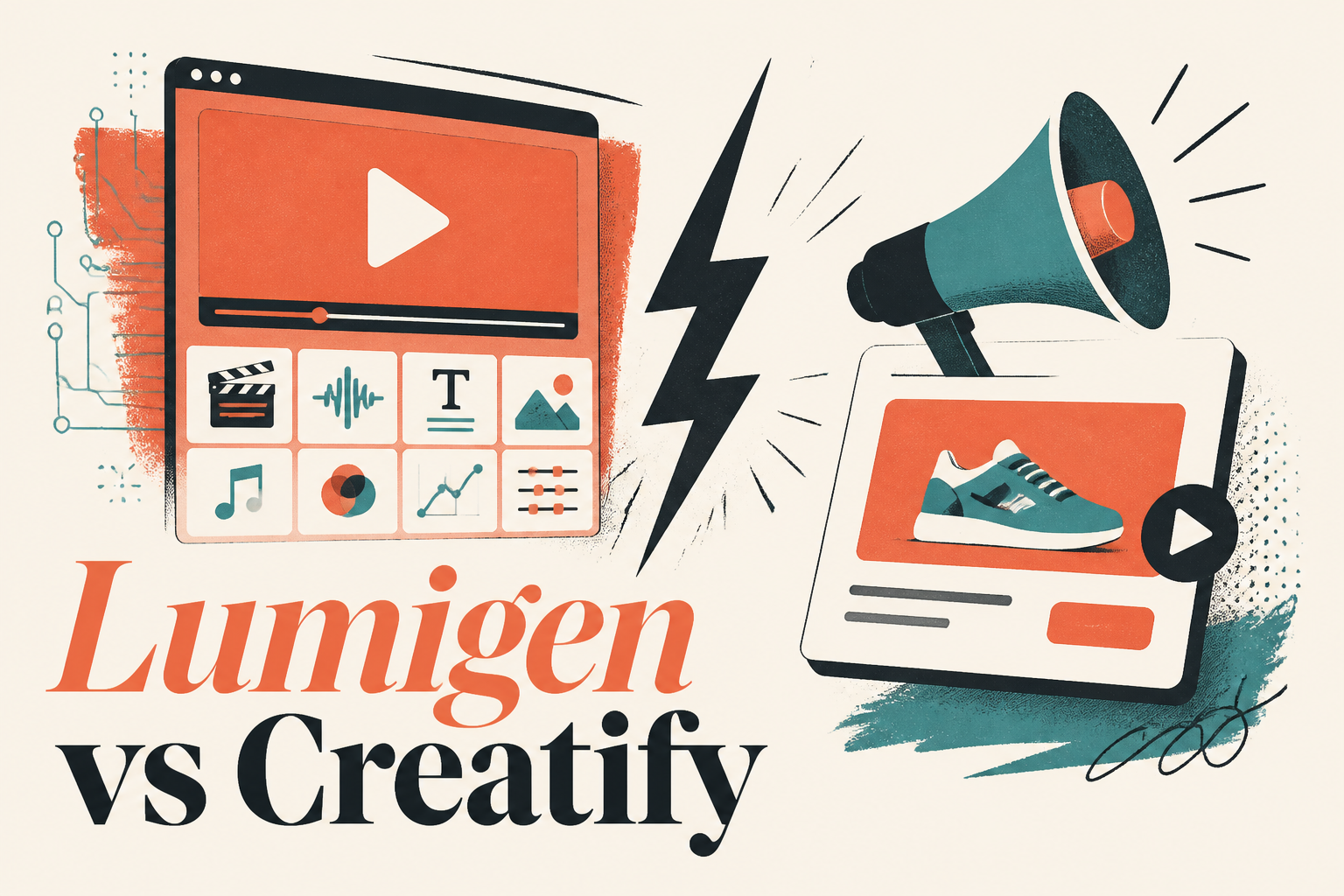
Lumigen and Creatify solve different problems, and the search "Lumigen vs Creatify" usually means one question: do I need an ad machine or a video stack? Creatify is a purpose-built UGC ad generator - paste a product URL, get ad variants, A/B test them, launch to Meta and TikTok. It wins on avatar count (1,500+) and ad-account integrations. Lumigen is a full original-video tool: script-to-video, AI avatars, faceless YouTube, and frontier models like Veo 3.1 and Kling 3.0, with UGC ads as one capability among many. Pick Creatify if your whole job is high-volume product ads. Pick Lumigen if you need video beyond ads, the best output quality, or transparent per-credit pricing. The table below maps it out.
| Dimension | Lumigen | Creatify |
|---|---|---|
| Core job | Full video stack (script, avatar, faceless, ads) | URL-to-ad UGC generator |
| AI avatars | 50+ | 1,500+ |
| Frontier models | Veo 3.1, Kling 3.0, Sora 2 Pro (Ultra) | Not the focus |
| Languages | 30+ | 75+ |
| Ad-account launch | Manual export | Native to Meta, TikTok, AppLovin |
| Free tier | None (Starter from $33/mo) | Yes (watermarked) |
| Watermark on paid | Never | Removed on paid |
What each tool actually does
Creatify is an ad factory. Its flagship workflow is URL-to-video: paste a live product link, and within seconds it scrapes the page, drafts a script trained on top-performing ads, and produces a first ad draft, per Creatify's UGC use-case page. Add batch mode and you can spin dozens of hook-and-CTA variations for A/B testing, then publish straight to Meta, TikTok, or Shopify. It is narrow on purpose, and the narrowness is the point for performance marketers.
Lumigen is a broader tool. It turns a script, idea, or prompt into a finished video through script-to-video, AI avatars, voiceovers in 30+ languages, and 26+ visual styles - then exports clean. UGC ads are covered through the UGC generator, but so are faceless YouTube, short-form social, and cinematic frontier-model output. Where Creatify ends at the ad, Lumigen keeps going into every other kind of video a creator ships.
Avatars and output quality
Creatify wins the avatar headcount easily: 1,500+ AI actors with lip-sync across 75+ languages versus Lumigen's 50+ avatars across 30+ languages. If your work is avatar-led product ads at volume, that library depth matters. But headcount isn't the same as quality. Independent reviews note that many free and lower-tier Creatify avatars show stiff body movement and lip-sync drift that read as obviously AI, with the most realistic avatars gated to higher plans, per EzUGC's review. When we generated the same product spot in both, Creatify's URL-to-video gave a usable draft in under a minute, but the free-tier avatar's mouth lagged the audio; Lumigen needed a pasted script, yet its frontier-model output looked cinematic rather than "AI presenter."
That gap is the real divide. Creatify optimizes for speed and volume of avatar ads. Lumigen optimizes for output that doesn't announce itself as AI - which is why frontier models (Veo 3.1, Kling 3.0, Sora 2 Pro) sit on its Ultra tier. For an ad you'll run for a week, Creatify's speed wins. For evergreen content you'll keep, Lumigen's quality wins.
Pricing
Creatify is cheaper to start and has a free tier; Lumigen has no permanent free plan but never watermarks a paid export. Creatify's free plan gives ~10 credits (about 2 videos) a month with a watermark, paid plans start around $19/month for watermark-free exports, Pro runs ~$49/month for the full 1,500-avatar library and batch mode, and Business is ~$195/month, per Creatify's pricing page. Note that Creatify credits expire every two months, and multiple reviewers flag billing friction - unauthorized charges and cancellation problems - on Trustpilot.
Lumigen uses transparent per-credit pricing where you see the exact credit cost before you generate. Starter is $33/month (1,500 credits), Growth is $58/month, and Ultra is $166/month with frontier models, per Lumigen's pricing. At roughly $1.50 per video on Starter, the math is legible rather than buried in opaque tokens.
| Plan level | Lumigen | Creatify |
|---|---|---|
| Free | None | Free (watermarked) |
| Entry paid | Starter $33/mo | ~$19/mo |
| Mid | Growth $58/mo | Pro ~$49/mo |
| Top | Ultra $166/mo (frontier) | Business ~$195/mo |
Ease of use and support
Both tools are built for non-editors, but they front-load different work. Creatify's URL-to-video means your first ad exists before you've written anything - ideal when you're testing 30 product angles and don't want to script each one. Its smart editor allows unlimited pre-export tweaks and one-click publishing, which keeps the whole loop inside ad-account workflows.
Lumigen asks for a script or prompt up front, then handles voice, avatar, visuals, captions, and export in one pass. That's marginally more effort per video but gives you control over the narrative, not just the ad hook. On support, Creatify's recurring complaints concern billing and cancellations; Lumigen's transparent-credit model and standard support avoid the renewal-surprise pattern that shows up in Creatify reviews. Neither is hard to learn - the difference is whether you want an automated ad draft or a controlled creative pass.
Where Lumigen falls short
Honesty matters in a comparison, so here's where Creatify genuinely beats Lumigen:
- Avatar library: 1,500+ vs 50+. For sheer face variety in ads, Creatify wins.
- Languages: 75+ vs 30+. Broader multilingual avatar coverage.
- Native ad launch: Creatify publishes directly to Meta, TikTok, and AppLovin; Lumigen exports and you upload.
- Free tier: Creatify has one (watermarked); Lumigen starts at $33/mo.
If your only job is paste-a-URL ad volume launched straight into ad accounts, Creatify is the specialist and you should use it.
Lumigen capabilities beyond ads:
- Script-to-Video - paste a script, get a finished video with voice and avatar
- AI Avatars - realistic avatars across age, gender, and language
- UGC Ads - creator-style ad variants for paid social
- Faceless YouTube - automated long-form video without an on-screen presenter
- Frontier Models - Veo 3.1, Kling 3.0, Sora 2 Pro on Ultra
The verdict
Pick Creatify if you live inside Meta and TikTok ad managers, need URL-to-ad volume, want the biggest avatar library, and value a free tier to start. Pick Lumigen if you need video beyond ads - script-to-video, faceless YouTube, multilingual originals - or if output that doesn't look AI-generated is the priority, thanks to frontier models on Ultra. Use Creatify where it's genuinely stronger: high-volume avatar ads launched straight to ad accounts. But if the question is "what's the fastest path from an idea to a publish-ready video across every format, not just ads, at the highest quality?" start with Lumigen's script-to-video or jump to pricing to match a plan to your volume.
Frequently asked questions
For pure ad volume, Creatify is the specialist - URL-to-video, batch variations, and native launch to Meta and TikTok. Lumigen covers UGC ads through its UGC generator but is built for a wider range of video, so it wins when ads are only part of your output.
Creatify has a free plan with about 10 credits a month, but exports carry a watermark. Lumigen has no permanent free tier; it starts at $33/month and never watermarks a paid export. See pricing.
Creatify has far more avatars (1,500+ vs 50+) and more languages. But reviewers note its cheaper avatars can look stiff, with the most realistic ones gated to higher plans. Lumigen has fewer avatars but pairs them with frontier video models for more natural output.
Creatify is cheaper to start (free tier, paid from ~$19/mo). Lumigen starts at $33/mo but uses transparent per-credit pricing and never watermarks. Factor in that Creatify credits expire every two months.
Lumigen covers URL-free UGC ad creation, avatars, and multi-format export, but it doesn't paste-a-URL-and-auto-launch into ad accounts the way Creatify does. If that specific automation is your core workflow, Creatify fits better. For everything else, start with Lumigen's script-to-video.
Related reads


Same prompt.
Four models.
One project.
Sora 2, Veo 3.1, Runway Gen-4, Kling 3.0 — side by side, with a free tier that's actually useful for evaluation. Three videos at full quality, no watermark, no minute cap.

Vlad
Founder of Lumigen. Has shipped tens of thousands of generations across Sora 2, Veo 3.1, Runway Gen-4, and Kling 3.0 — and edits everything published here against that hands-on test bed.