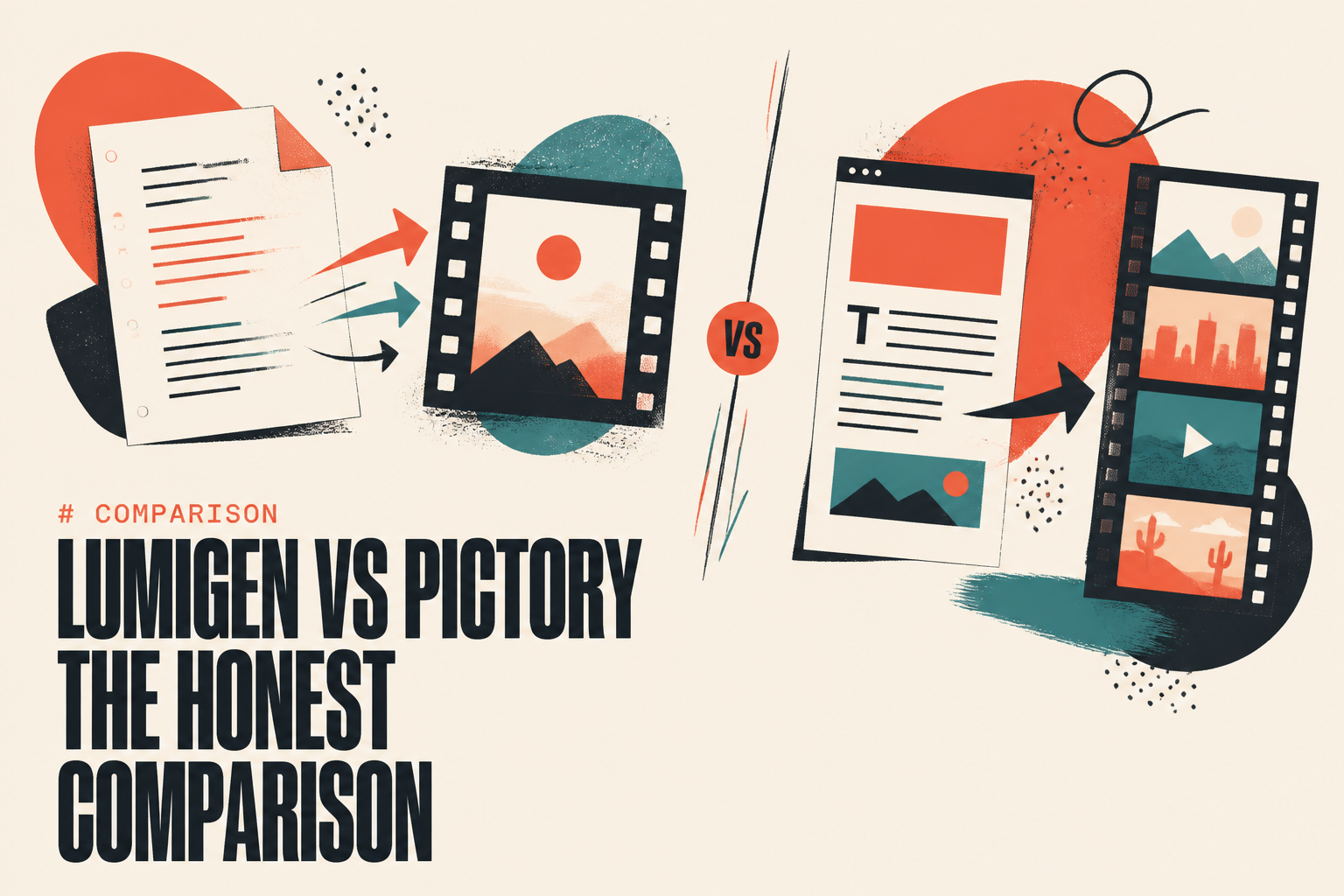
Pictory and Lumigen both show up in the same searches - "best AI video generator," "script to video," "blog to video" - but they solve two different problems. Pictory assembles videos out of stock footage and AI voiceover to repurpose long-form content (blogs, webinars, podcasts) into short videos. Lumigen generates original AI video from scratch using avatars, voices, frontier video models, and 26+ visual styles. If your input is "I have a 2,000-word blog post and I want a 90-second highlight video," Pictory is faster. If your input is "I have a script and I want an avatar talking-head video, or I want a UGC-style ad, or I want a cinematic short," Lumigen is the one. The wrong-shape tool wastes a month of credits while you fight the workflow.
This guide compares Lumigen and Pictory across the five dimensions that actually matter when picking between them: input model, output style, pricing and credit math, output quality and language coverage, and ideal user profile. We use real prices from both products' pricing pages as of May 2026 and ground the feature comparison in what each tool actually ships, not what they advertise.
Selection criteria for this comparison
Before the head-to-head: the lens we used. Five questions narrow the Lumigen-vs-Pictory decision faster than any feature checklist.
What is your input? Pictory is built around the repurposing workflow - the input is existing long-form content (a blog post URL, a webinar recording, a podcast file) that the tool summarizes and pairs with stock footage. Lumigen is built around the generation workflow - the input is a script or a prompt, and the tool generates new video from scratch. If you do not have long-form content to repurpose, Pictory's main workflow does not fit.
What kind of video do you need? Pictory ships stock-footage-driven videos. The visual style is determined by the stock library and the AI's footage-matching. Lumigen ships avatar-driven videos, UGC-style ad creative, and original AI-generated cinematic video. The visual style is determined by what you generate, not what is in a library.
Who is the talent on camera? Pictory has AI voices but the visuals are stock footage clips - no on-camera presenter. Lumigen has 50+ AI avatars that act as the on-camera presenter, plus the option to generate UGC-style creator-look footage or fully generated scenes.
What is your budget? Pictory's Standard tier starts at $25/mo annual. Lumigen's Starter starts at $33/mo annual. The cheaper floor is Pictory; the broader workflow is Lumigen. The credit-math comparison gets more interesting on the upper tiers.
How important is frontier-model video output? Pictory does not use frontier text-to-video models (Veo 3.1, Kling 3.0, Sora 2 Pro). Lumigen gates those to the Ultra tier ($166/mo) and they are the differentiator if you want generated cinematic shots rather than stock-footage assembly.
TL;DR - feature comparison table
| Dimension | Lumigen | Pictory |
|---|---|---|
| Primary input | Script, prompt, idea | Blog URL, long video, podcast, script |
| Output style | Avatar talking-head, UGC ads, frontier-model generated video, 26+ visual styles | Stock-footage assembly with AI voiceover |
| AI avatars | 50+ across age, gender, language | None (voice-only, no on-camera presenter) |
| Voice options | 50+ voices, 30+ languages, ElevenLabs premium on Growth+ | Multiple AI voices, ~30 languages |
| Stock library | Available but not the primary path | 3M+ video clips (core of the product) |
| Frontier video models | Veo 3.1, Kling 3.0, Sora 2 Pro on Ultra | Not available |
| UGC ad workflow | Yes (Ultra tier) | No |
| Lip-sync correction | Yes (built into avatar workflow) | N/A (no on-camera presenter) |
| Blog-to-video | Indirect (paste text as script) | Native (paste URL or text) |
| Podcast/webinar to shorts | Indirect | Native (auto-summarize long video) |
| Auto-captions | Yes | Yes |
| Vertical export (9:16) | Yes | Yes |
| Starting price | $33/mo Starter (annual) | $25/mo Standard (annual) |
| Mid tier | $58/mo Growth | $47/mo Professional |
| Top tier | $166/mo Ultra (with frontier models) | $119/mo Teams |
| Free tier | None (annual discount instead) | 14-day free trial |
| Best for | Original AI video, avatars, UGC ads, frontier output | Repurposing existing long content into shorts |
Input model - what each tool wants from you
Pictory's core workflow is repurposing. You give it a long input - a blog post URL, a 60-minute webinar recording, a podcast episode, a Zoom transcript - and the tool AI-summarizes it into a shorter script and pairs the script with stock footage from a 3M+ clip library. The audio is AI voiceover. The visual is a sequence of stock clips matched to the script's content. This is the right shape for a marketing team that already produces blog content weekly and wants every blog auto-converted into a 60-second TikTok or LinkedIn video, or for a podcaster who wants every episode chunked into shareable shorts.
Lumigen's core workflow is generation. You give it a script (you can paste a blog post into the script box, but that is one input among many) and Lumigen generates the video from scratch. The visuals can be an avatar speaking your script, a UGC-style creator video, a fully generated cinematic short using Veo 3.1 or Kling 3.0, or a mix of styles. The audio is AI voiceover - 50+ voices, 30+ languages, ElevenLabs premium starting at the Growth tier. This is the right shape for a creator who wants original AI-generated video where the on-camera presenter is an AI avatar, not a stock-footage placeholder.
The decision hinges on whether you already have the long-form content. If yes, Pictory saves you the work of writing the script. If no, Lumigen's avatar-and-script workflow is a finished video; Pictory's workflow is a stock-footage montage that may or may not look like what you wanted.
Output style - stock-footage assembly vs. original generation
Pictory output is visually a sequence of stock-footage clips with text overlays and an AI voiceover narrating. The library is large (3M+ clips) but the look is recognizable - the same kind of footage you see in B-roll-heavy explainer videos. The AI does the footage-matching automatically: the script mentions "AI productivity tools" and Pictory pulls a clip of someone typing on a laptop with a glowing UI overlay. The footage matching is good for what it is, and for repurposing blog content into a shareable video this is exactly what you want. It is fast, it is consistent, it is hands-off.
Lumigen output is generated, not assembled. An avatar speaks your script with lip-sync correction baked in. A UGC ad shows a creator-style avatar holding a generic product mockup and delivering a testimonial. A cinematic short uses frontier video models (Veo 3.1, Kling 3.0, Sora 2 Pro) to produce shots that look like original cinematography rather than stock library clips. The visual style is determined by the model and the prompt, not by what was sitting in a library. This is the right output if you want video that looks like it was made for you, not pulled from a shared pool.
For a clear comparison: a 60-second video about "the best email marketing software" rendered in Pictory looks like a stock-footage montage with AI voiceover. The same script rendered in Lumigen looks like an avatar speaking directly to camera, or like an original generated scene, depending on which style you pick. Both are watchable. They are not interchangeable. The right pick depends on what you want the finished video to look like.
Pricing and credit math
Pictory's published pricing (May 2026, annual billing):
- Standard: $25/mo - 30 videos/mo up to 10 minutes each, voiceover, transcription
- Professional: $47/mo - 90 videos/mo up to 20 minutes each, multiple brand kits, premium voices
- Teams: $119/mo - 225 videos/mo up to 30 minutes each, collaboration
Lumigen's published pricing (May 2026, annual billing):
- Starter: $33/mo - 1,500 credits/mo, image gen + edit, script gen, OpenAI TTS
- Growth: $58/mo - 3,500 credits/mo, adds ElevenLabs premium, standard video models, AI avatars
- Ultra: $166/mo - 10,000 credits/mo, adds UGC Hub, frontier models (Kling 3.0, Veo 3.1, Sora 2 Pro)
The published prices look like Pictory is cheaper at every tier, but the credit math is not directly comparable. Pictory's quota is "X videos per month, up to Y minutes." Lumigen's quota is credits, which spend differently depending on what you generate - a 60-second avatar talking-head video at standard quality is roughly 40-80 credits on Growth (so a Growth subscriber gets ~50 videos/mo at that profile). A 30-second Veo 3.1 cinematic shot on Ultra is more credit-heavy because the model itself is more expensive per second of output.
The right comparison: if you want a guaranteed video count per month and the workflow is repurposing blog/podcast content into stock-footage shorts, Pictory's video-quota pricing is more predictable. If you want flexible credit math where you spend credits on the specific quality tier you need (cheap standard-model output for ad variants, expensive frontier-model output for one hero cinematic), Lumigen's credit-based pricing is more flexible.
Output quality and language coverage
Pictory's output quality is dependent on the stock library and the AI's footage-matching accuracy. For mainstream topics (productivity, software, business, lifestyle, fitness, food), the library covers it well and the matching is good. For niche topics (specialized B2B SaaS, scientific concepts, technical workflows), the library starts to thin and the footage-matching gets generic. The AI voiceover is solid across the dozen-or-so primary voices and across 30+ languages, though English-Spanish-French-German are the strongest cases as with every multilingual AI voice tool.
Lumigen's output quality is dependent on which model and tier you pick. Standard tier video models (Runway, Hailuo, Grok, SeeDance on Growth+) produce results in the same quality bracket as most generated-AI-video competitors. Frontier models on Ultra (Kling 3.0, Veo 3.1, Sora 2 Pro until its September 2026 sunset, SeeDance 2, Happy Horse 1.0) produce results in the category-leading bracket - the same models that show up in our frontier-model comparison post. Avatar quality is good across the 50+ library, with lip-sync correction baked in. Voice quality matches ElevenLabs premium on Growth and up (which is the current best-in-class for AI voice).
For multilingual workflows, Lumigen ships 30+ languages with native voice generation and lip-sync that matches the spoken language. Pictory ships ~30 languages of AI voiceover but the visual layer is stock footage that does not change by language - which is fine for repurposing English blog content into Spanish-voiceover shorts, less fine for original Spanish-first video where you want an on-camera Spanish-speaking avatar.
Ideal user profile - who picks which tool
Pictory is the right pick for a marketing team or content creator with an existing content engine. The use cases that fit are:
- Bloggers who publish weekly long-form posts and want every post auto-converted into a 60-second social video for distribution
- Podcasters who want every episode chunked into shareable shorts with auto-captions and a stock-footage visual layer
- Webinar producers who need post-event highlight reels without manual editing
- Marketing teams running a content repurposing workflow at scale where the visual content is "good enough" stock footage rather than something custom
Lumigen is the right pick for a creator or small team that needs original generated video. The use cases that fit:
- Solo creators and indie founders shipping a video weekly where the look needs to be specific (an avatar talking head, a UGC-style ad, a cinematic short)
- Indie ad buyers running paid social tests that need 30 lip-synced UGC ad variants from the same script with different avatars and voices
- Faceless YouTube channels where the workflow is script → AI narration → generated visuals → captions → publish, in one tool
- Bilingual creators who need the same script rendered in 30+ languages with native voice generation and matching lip-sync
- Agencies producing ad creative at volume where the budget supports the Ultra tier and frontier-model output is the differentiator
The middle case - a creator who has some long-form content to repurpose but also wants original generated video - is the trickiest. The honest answer is that you might want both, with Pictory for the repurposing layer and Lumigen for the original generation layer. The credit math gets ugly if you actually run both at scale, but for a content team mixing both workflows, that is the real answer.
Where Lumigen falls short vs Pictory
Honest constraints. Lumigen does not win on every dimension.
- No native blog-to-video pipeline. Pictory parses a blog URL, summarizes it, and auto-generates the matching video in one step. Lumigen requires you to paste the script in manually. For weekly blog repurposing at volume, Pictory is faster.
- No long-video summarization. Pictory's auto-summarize for podcasts and webinars is genuinely useful. Lumigen does not currently chunk a 60-minute video into shorts; the workflow assumes you already have the script for what you want to generate.
- Lower entry price. Pictory Standard is $25/mo; Lumigen Starter is $33/mo. For a creator on the lowest budget who only needs the most basic workflow, Pictory wins on entry price.
- No 14-day free trial. Pictory ships a free trial; Lumigen does not. The annual-discount model is the trade-off, but for evaluators who want to test before paying anything, Pictory's trial is the easier on-ramp.
- Less of a "set it and forget it" workflow. Pictory's blog-to-video auto-pipeline is hands-off; Lumigen's script-to-video editor is more hands-on. For someone who wants the video done for them, Pictory does more work; for someone who wants the video done their way, Lumigen gives more control.
Where Pictory falls short vs Lumigen
The other direction. Pictory does not win on every dimension either.
- No avatar talking-head. Pictory has voiceover but no on-camera AI presenter. If your video format requires a face delivering the script, Pictory cannot ship it; Lumigen's 50+ avatar library covers it directly.
- No original video generation. Pictory assembles stock footage. It does not generate new video from a prompt. For original cinematic shots or UGC-style ad creative that does not exist in any stock library, you need a tool that actually generates video - which is what Lumigen is built for.
- No frontier-model video output. Veo 3.1, Kling 3.0, and Sora 2 Pro produce a different category of output than stock-footage assembly. Pictory does not access these models; Lumigen's Ultra tier does.
- No UGC ad workflow. The UGC Hub for ad-creative variants at scale is a Lumigen Ultra feature with no Pictory equivalent. For paid social testing where the workflow is "same testimonial script, five avatars, three languages each," Pictory's stock-footage shape does not fit.
- Limited multilingual on the visual layer. Pictory's stock footage does not change by language; the AI voiceover does. For a creator who needs the on-camera presenter to look and speak like the target audience, this is a constraint.
How to use Lumigen if you have been using Pictory
If you are migrating from Pictory or evaluating Lumigen as a complement, here is how the workflow shifts:
- Paste your script into Lumigen's script-to-video editor. If your input is a blog post, paste the post text. Lumigen does not parse URLs but it does accept long text directly.
- Pick a tier - Growth ($58/mo) for standard quality with AI avatars and ElevenLabs voices, Ultra ($166/mo) if you want frontier video models (Veo 3.1, Kling 3.0, Sora 2 Pro) for cinematic shots. See pricing for credit math.
- Choose how the video looks. For a Pictory-equivalent stock-footage style, pick a non-avatar style and let Lumigen generate scenes from the script. For a more distinctive original-video look, pick an avatar talking-head, a UGC-style ad, or a fully generated cinematic short.
- Pick a voice from 50+ across 30+ languages. ElevenLabs premium voices are available from Growth and up.
- Generate the first pass. Lumigen renders the video scene-by-scene; you can re-roll individual scenes that did not land.
- Refine - caption styling, lip-sync correction on avatar scenes, scene re-generation, music bed selection.
- Export 9:16 for TikTok/Reels, 1:1 for Instagram in-feed, 16:9 for YouTube/LinkedIn.
The biggest workflow difference vs Pictory: Lumigen renders each scene from scratch rather than pulling from a stock library. That means scenes look distinctive to your video instead of recognizable from someone else's. The trade-off is that generation is slower than stock-footage matching - a 60-second video takes a few minutes on standard models, longer on frontier models.
The full 12-tool AI video generator comparison covers Pictory, Lumigen, and 10 others side by side.
Verdict - pick Lumigen if, pick Pictory if
The honest decision frame.
Pick Pictory if your input is existing long-form content (blog posts, webinars, podcasts) and your goal is fast repurposing into stock-footage-style social shorts with AI voiceover. The blog-to-video pipeline is the strongest feature on this comparison and Pictory wins it cleanly. The $25/mo entry price is the lowest. The 14-day free trial is the easiest on-ramp for evaluators. If "repurpose every blog into a 60-second LinkedIn video, hands-off, by Friday" is the brief, Pictory is the answer.
Pick Lumigen if your input is a script (or an idea, or a prompt) and your goal is original generated video - an avatar talking-head, a UGC-style ad, a fully generated cinematic short, or all three from the same workspace. The avatar library, the frontier-model access, the UGC ad workflow, and the script-to-video editor are what you are paying for. If "produce 30 lip-synced ad variants for a paid social test, with five avatars, three languages each, by next Tuesday" is the brief, Lumigen is the answer.
Pick both if you run a content team that does both workflows. Pictory for the repurposing layer where the input is long content and the visual layer is stock footage. Lumigen for the original-generation layer where the input is a script and the visual layer is generated. The combined credit math gets expensive at scale, but for teams mixing both jobs, that is the real answer.
Frequently asked questions
Not quite - Lumigen and Pictory solve overlapping but different problems. Pictory specializes in stock-footage-based video assembled from long-form text input (blog posts, podcasts, webinars). Lumigen specializes in original AI video generation (avatars, UGC ads, frontier-model cinematic shots) from a script or prompt. If your job is blog-to-video repurposing, Pictory fits cleaner. If your job is generating original video where an avatar or AI-generated scene is the visual layer, Lumigen fits cleaner.
Pictory's entry tier ($25/mo Standard, annual) is cheaper than Lumigen's entry tier ($33/mo Starter, annual). At mid tier, Pictory Professional ($47/mo) is also cheaper than Lumigen Growth ($58/mo). At top tier, Lumigen Ultra ($166/mo) is more expensive than Pictory Teams ($119/mo), but Ultra includes frontier video models (Veo 3.1, Kling 3.0, Sora 2 Pro) that Pictory does not access. The right "cheaper" answer depends on what you need the tool to do - Pictory is cheaper for stock-footage repurposing; Lumigen Ultra is the only option in this comparison for frontier-model output.
No. Pictory uses AI voiceover but does not have on-camera AI avatars. The visuals are stock-footage clips matched to the script. For avatar talking-head video, you need a tool with an avatar library - Lumigen ships 50+ avatars, or look at HeyGen, Synthesia, or D-ID. Pictory and avatar tools solve different jobs; the right answer depends on whether you want the on-camera presenter to be an AI face or a sequence of stock clips with voiceover.
Indirectly. You can paste a blog post's text into Lumigen's script-to-video editor and generate a video from it, but Lumigen does not parse a blog URL or auto-summarize a long-form post the way Pictory's pipeline does. For high-volume hands-off blog repurposing, Pictory is faster. For blog-driven video where you want the output to be an avatar or a generated scene rather than stock footage, Lumigen is the cleaner pick once you do the summarization step manually.
Output quality is not directly comparable because the two tools produce different categories of video. Pictory's output is stock-footage assembly with AI voiceover - the quality is consistent and good for what it is, and the AI's footage-matching is solid for mainstream topics. Lumigen's output is generated video - avatar talking-head, UGC ads, or frontier-model cinematic. On the frontier-model tier (Lumigen Ultra), the output is category-leading for AI-generated video. On Lumigen Growth with standard models, output sits in the same bracket as most generated-AI-video competitors. Pick by which output style fits your video, not by a head-to-head quality score.
No. Pictory does not currently integrate text-to-video frontier models (Sora 2 Pro, Veo 3.1, Kling 3.0). The product's value proposition is stock-footage assembly, not generated video. For frontier-model output you need a tool that wires those models in - Lumigen Ultra ships Veo 3.1, Kling 3.0, Sora 2 Pro (until its September 2026 sunset), SeeDance 2, and Happy Horse 1.0. Note that Sora 2 Pro is sunsetting in September 2026; for new pipelines built today, Veo 3.1 is the safer default in that bracket.
Pictory offers a 14-day free trial with limited output. Lumigen does not offer a permanent free tier; it ships annual-billing discounts instead (roughly 20% off monthly). For evaluators who want to test before paying anything, Pictory's trial is the easier on-ramp. For creators ready to commit to a paid tool, Lumigen's annual pricing on Starter ($33/mo) or Growth ($58/mo) is the entry point.
The bottom line
Pictory wins on stock-footage repurposing of long-form content, on entry price, on the free trial, and on hands-off blog-to-video automation. Use it when your input is already-written long content and your output is a stock-footage social short.
But if the question is "what is the fastest path from a script to a publish-ready original AI video at the highest output quality?" - start with Lumigen. Try script-to-video with avatars on the Growth tier, or jump to pricing and the Ultra tier for frontier-model cinematic output and the UGC ad workflow that Pictory does not offer.
Related reads


Same prompt.
Four models.
One project.
Sora 2, Veo 3.1, Runway Gen-4, Kling 3.0 — side by side, with a free tier that's actually useful for evaluation. Three videos at full quality, no watermark, no minute cap.

Vlad
Founder of Lumigen. Has shipped tens of thousands of generations across Sora 2, Veo 3.1, Runway Gen-4, and Kling 3.0 — and edits everything published here against that hands-on test bed.