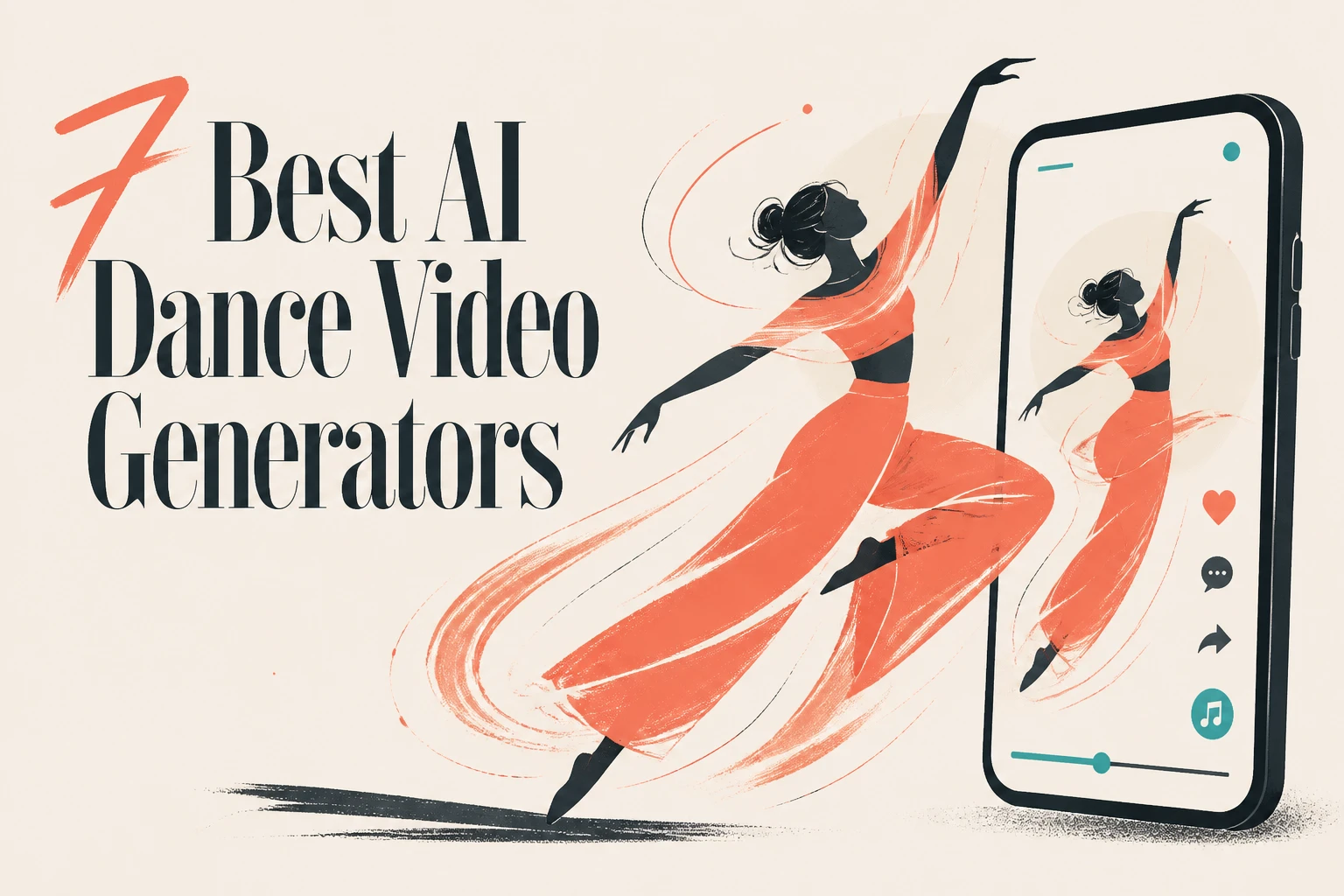
Quick verdict. An AI dance video generator turns a still photo or a written prompt into a clip of a person, character, or pet dancing - no choreography, no camera, no rigging. After testing seven of them on the same photos and the same TikTok-style briefs, the split is clear: Lumigen wins when you want original dance footage at frontier-model quality inside a full short-form pipeline; Viggle wins for free single-image motion-transfer clips; Kling wins on raw motion fidelity; Vidu and Media.io win for fast no-cost photo-to-dance; Mango AI wins for cartoon and pet dances; and freebeat wins for music-synced dance videos. Most creators need exactly two of these, and which two depends on one question: are you animating an existing image, or generating a dancing scene from scratch?
Almost every "AI dance video generator" page you'll land on is a tool's own product page promising you'll "make any photo dance in seconds." That's true, and it's also where the honesty usually stops. The clips these tools produce range from genuinely viral to obviously broken, and the difference is not the marketing - it's the underlying motion engine and what you feed it. The search term itself is transactional: "ai dance video generator" pulls roughly 880 searches a month in the US with a $3.32 CPC, which is high commercial intent for a niche this specific (DataForSEO, June 2026). People aren't browsing. They want the tool that works.
This post is the tested roundup the SERP is missing. If you're brand new to AI video, start with the complete beginner's guide first, then come back. For the broad generalist ranking, see the 12 best AI video generators in 2026. This page stays on one job: making a dance video with AI.
Who this is for
You want a dancing clip for TikTok, Reels, or Shorts, and you don't want to learn After Effects or hire a motion designer to get it. Maybe you have one good photo of a character, a mascot, or yourself, and you want it to do a trending dance. Maybe you're running a faceless channel and you need original dance scenes that don't reuse the same stock loop everyone else is posting. Either way, you've already noticed the core problem: most AI dance clips look like AI dance clips.
You're also done with listicles that recommend ten tools without testing one. You want to know which generator handles the part that actually breaks - the hands, the fast limb crossovers, the moment the motion tears and the illusion dies. That's the dimension this ranking weights heaviest.
What we tested for
AI dance video is a brutal test of a motion model. A talking-head clip can hide a weak engine behind a static torso. A dance clip can't - the whole frame is moving, limbs cross, hands occlude the body, and the human eye is exceptionally good at spotting motion that's physically wrong. We fed each tool the same inputs and judged on what survives the export.
The six criteria, weighted:
- Motion realism on fast movement - the giveaway in every AI dance clip is the hands and the limb crossovers. Tools that smear or duplicate fingers on a fast move are unusable for anything but a meme.
- Input model - motion transfer (animate an existing photo) versus original generation (create a dancing scene from a prompt). These are different jobs and most tools only do one well.
- Free tier reality - "free" usually means watermarked, login-gated, or capped at a few seconds. We checked what you actually get without paying.
- TikTok-ready export - native 9:16 vertical, sane length, and an export that matches the preview. Misaligned exports are a documented complaint across this whole category.
- Control - can you direct the dance, the style, and the scene, or do you take whatever the template gives you?
- Speed and batch - posting a daily trend means generation in minutes, not a render queue.
We did not weight enterprise features, team seats, or commercial licensing. This is a creator-grade ranking.
The 7 tools at a glance
The table compresses the testing into one view. The "best for" column is the narrow win - the specific dimension where each tool earns its place rather than a generic "great tool" award.
| Rank | Tool | Best for | Input model | Free tier | Native 9:16 |
|---|---|---|---|---|---|
| 1 | Lumigen | Original dance scenes at frontier quality | Prompt + image, original generation | No (paid from $33/mo) | Yes |
| 2 | Viggle AI | Free single-image motion transfer | Photo + dance template | Yes (watermarked) | Yes |
| 3 | Kling AI | Raw cinematic motion fidelity | Image-to-video + Motion Brush | Limited free credits | Yes |
| 4 | Vidu AI | Fast no-cost photo-to-dance | Photo + template | Yes (basic) | Yes |
| 5 | Media.io | Browser, no-login quick dance | Photo + effect | Yes (limited) | Yes |
| 6 | Mango AI | Cartoon and pet dancing | Photo, appearance-preserving | Yes (limited) | Yes |
| 7 | freebeat | Music-synced dance and lyric videos | Song + style | Limited free | Yes |
The split is intuitive once you see it. Motion-transfer tools (Viggle, Vidu, Media.io, Mango AI) animate an image you already have. Original-generation tools (Lumigen, Kling) build a dancing scene from a prompt. freebeat is its own lane - it starts from a song. If you have a character and want it to dance, you're in motion-transfer. If you want a new scene that never existed, you're in generation. Most creators eventually need both.
1. Lumigen: best AI dance video generator overall
Best for: Creators who want original dance scenes - not just a puppet of one photo - at frontier-model motion quality, with the full short-form pipeline (prompt, voice, captions, 9:16 export) in one tool.
Strongest use cases: Original dance scenes from a prompt, character dances with consistent appearance, motion-control re-animation of a still, faceless dance-trend channels, multi-language dance clips, TikTok and Reels trend batching.
Starting price: $33/mo Starter, $58/mo Growth, $166/mo Ultra (frontier models) - see pricing for credit math.
Why Lumigen is the best AI dance video generator
Most tools on this list do one trick: they take a photo and apply a canned dance to it. That's motion transfer, and it's genuinely useful - but it caps you at "this specific image, puppeted." Lumigen sits in the other lane. It generates original video from a prompt or an image, which means the dance, the dancer, the setting, and the camera move are all yours to direct rather than picked from a template gallery. For a creator who needs a fresh dancing scene every day, that's the difference between a channel that looks templated and one that doesn't.
The motion-quality reason is the bigger one. The thing that makes an AI dance clip look fake is fast-movement breakdown - smeared hands, duplicated fingers, limbs that pop through the torso on a crossover. That failure mode is a function of the video model. Lumigen routes generation through frontier video models - Kling 3.0, Veo 3.1, and Sora 2 Pro - on its Ultra tier, which is exactly where the motion-tearing problem is least bad. You're not getting a 2024-era engine with "AI dance" branding; you're getting the same class of model the cinematic tools use, pointed at a dance prompt. Add motion control for re-animating a still and face-swap for putting a specific face on a generated dancer, and the creative ceiling is much higher than a one-click template.
What makes Lumigen uniquely strong for dance content
Beyond the dance clip itself, Lumigen covers the whole short-form stack in one workflow: script-to-video for narrated dance explainers, AI avatars and avatar creation for a recurring character dancer, motion control for animating a still photo, an image generator to design the dancer before you animate them, voice cloning across 30+ languages, UGC ad generation for dance-led product ads, 26+ visual styles, lip-sync correction, and 9:16 vertical export. The frontier models (Veo 3.1, Kling 3.0, Sora 2 Pro until its September 2026 sunset, SeeDance 2, Happy Horse 1.0) live on the Ultra tier. See pricing for the credit math.
How to use Lumigen for an AI dance video
Here's the workflow we'd run for a TikTok dance trend:
- Design or upload your dancer in the image generator - a character, a mascot, or a real photo.
- Open create-video and write the dance prompt: the move, the setting, the camera, the energy.
- Pick a tier - Growth ($58/mo) for standard models, Ultra ($166/mo) for Veo 3.1 or Kling 3.0 when motion fidelity matters most.
- For animating a specific still rather than generating fresh, use motion control to drive the pose.
- Generate the first pass, then re-roll the scenes where the hands break.
- Layer a voice or trending-audio cue and burn captions if the trend needs them.
- Export 9:16 for TikTok, Reels, or Shorts.
The point isn't one perfect clip. It's running the trend five different ways in an afternoon and posting the one that moves.
Where Lumigen falls short
Honest constraints, because they matter:
- No one-click "make this photo dance" template. Viggle's single-image-to-dance flow is faster and simpler if all you want is one photo puppeted to a known move. If you need that one specific thing, use Viggle instead.
- No permanent free tier. Vidu and Media.io let you make a dance clip for $0 (watermarked). Lumigen starts at $33/mo. If budget is genuinely zero, start free elsewhere.
- Frontier models are Ultra-only. The best motion quality (Kling 3.0, Veo 3.1) is gated to the $166/mo Ultra tier. Growth gets you standard models, which are good but not class-leading on fast motion.
- It's a full tool, not a toy. The flexibility means a few more clicks than a template app. For a true 30-second meme, a template tool is faster.
Lumigen capabilities for dance content
- Motion Control - drive a still image's pose and re-animate it
- Create Video - original dance scenes from a prompt, plus face-swap
- Image Generator - design the dancer before animating
- AI Avatars - a recurring character dancer across clips
- Script-to-Video - narrated dance explainers and tutorials
- Frontier models - Kling 3.0, Veo 3.1, Sora 2 Pro on Ultra for the cleanest motion
Is Lumigen the right AI dance video generator for you?
If you want a channel of original dance content that doesn't look templated, and you'll use the same tool for other short-form jobs, Lumigen is the best first tool to test - frontier motion quality plus a full pipeline beats a single-trick template app. Start with the create-video flow and motion control, or jump to pricing to find the plan that matches your posting volume.
2. Viggle AI: best free single-image motion transfer
Viggle is the tool that made AI dance go viral, and it's still the cleanest single-image-to-dance experience. Upload a clear photo - full-body or half-body works best - pick a dance template, and Viggle's motion-transfer engine animates the subject through the move without rigging or 3D software (Viggle, viggle.ai/tools/ai-dance). The free tier is real, with a watermark, which is why it dominates the trend-clip use case. If your entire goal is "make this one character do this one dance," Viggle is the fastest path to a postable clip.
The trade is the ceiling. Motion transfer puppets an existing image, so the output is only ever that photo animated - you can't change the scene, the camera, or generate a dancer that didn't exist. Fast moves still smear at the hands, and complex choreography exposes the seams. It's a clip tool, not a scene tool.
vs Lumigen: Viggle wins on speed and the free single-image flow; Lumigen wins when you need an original dancing scene rather than one photo puppeted, and its motion control plus frontier models hold up better on the fast crossovers that break transfer engines.
3. Kling AI: best raw motion fidelity
Kling is the industry reference for high-end motion. Its image-to-video and Motion Brush give frame-accurate, physically plausible movement that holds up on the exact fast-limb scenarios that wreck cheaper engines - which is why filmmakers reach for it on broadcast-grade work (multiple 2026 Viggle-alternative roundups, including CyberLink and DomoAI, name Kling the fidelity leader). For a dance clip where the motion has to look real, Kling's raw output is among the best you can buy.
The catch is that standalone Kling is a frontier model, not a creator app - it's credit-metered, has a learning curve, and gives you a single generation, not a pipeline with voices, captions, and export presets. There's a useful shortcut here, though: Kling 3.0 is one of the frontier models available inside Lumigen's Ultra tier, so you can get Kling-class motion with a creator workflow around it.
vs Lumigen: Kling wins on standalone motion fidelity; Lumigen gives you that same Kling 3.0 engine wrapped in a pipeline - script-to-video, captions, voices, and 9:16 export - so the dance clip becomes a finished post, not a raw render.
4. Vidu AI: best free no-cost photo-to-dance
Vidu offers a genuinely free AI dance option - upload a photo, pick a template, and generate a dancing clip at no cost, with free users getting basic features (Vidu, vidu.com/ai-dance-generator). It's fast and forgiving, which makes it a good first stop for testing whether a photo animates well before you commit budget anywhere. The motion is solid for simple moves and slower tempos.
Where it slips is the same place every template tool does: complex choreography and fast movement expose the engine, and the free tier caps quality and length. It's a great way to make a quick dancing clip for free; it's not where you build a consistent channel.
vs Lumigen: Vidu wins on the zero-cost entry point; Lumigen wins when the dance has to look production-grade and you need control over the scene rather than a template - try the create-video flow when you outgrow the free tier.
5. Media.io: best browser, no-login quick dance
Media.io runs entirely in the browser and leans into accessibility - upload a clear full-body or half-body photo, choose the AI dance effect, and generate, no install required (Media.io, media.io/ai-dance-generator.html). For a one-off dance clip when you don't want to create an account or download anything, it's about as low-friction as the category gets. The template library covers the common trending moves.
The limits are predictable for a free browser tool: watermarking and quality caps on the free tier, generic templates, and the usual fast-motion breakdown. It's a convenience tool, best for a quick experiment rather than a content engine.
vs Lumigen: Media.io wins on no-login convenience; Lumigen wins on output quality and originality - when you want a dance scene that's yours rather than a shared template, the image generator plus motion control combination is the upgrade.
6. Mango AI: best for cartoon and pet dancing
Mango AI (Mangoanimate) has a specific strength: it makes cartoon characters, illustrations, and pets dance while preserving their appearance - upload a photo of a person, character, or pet and the subject moves and dances without altering how it looks (Mango AI, mangoanimate.com/ai/ai-dance-generator). The dancing-pet and dancing-mascot trends are a real niche, and Mango's appearance-preserving animation is well suited to it where photorealistic engines tend to "correct" stylized art into something off-model.
The flip side is that its output reads as animation rather than realistic video, so it's the wrong tool for a realistic human dance clip. It's a specialist, and within its specialty it's a good pick.
vs Lumigen: Mango AI wins on cartoon and pet animation that respects the original art style; Lumigen wins on realistic human dance and original scenes, with avatars for a consistent character across a whole series.
7. freebeat: best for music-synced dance and lyric videos
freebeat starts from the other end of the problem - the music. Feed it a song and it generates a dance or lyric video synced to the track, which is a different job from animating a single photo (freebeat, freebeat.ai). For musicians, DJs, and creators whose dance content is driven by a specific song, the audio-first approach removes a step the photo-first tools leave to you. The beat-sync is the feature, and it's the reason to pick it.
The constraint is scope. freebeat is built around the music-video use case, so you get less control over a specific character or scene than a generation tool, and it's narrower than a general dance generator. If the song is the brief, it fits; if the character is the brief, it doesn't.
vs Lumigen: freebeat wins on music-synced dance and lyric videos; Lumigen wins when the dancer and the scene are the point - and for a song-led ad rather than an organic music video, the UGC video generator is the better conversion tool.
How to choose your AI dance video generator
The decision comes down to one branch, then a second:
Are you animating an existing image, or generating a scene from scratch?
- Animating an image - you have a photo and want it to dance. Start with Viggle (best free single-image flow) or Vidu and Media.io (free, no-login). For appearance-preserving cartoon or pet dances, Mango AI. For frame-accurate fidelity, Kling.
- Generating a scene - you want an original dancing clip that didn't exist. That's Lumigen (full pipeline, frontier models) or standalone Kling (raw model, no pipeline).
- Starting from a song - freebeat, the only music-first option here.
Then: free experiment or content engine? If you're testing a single clip and don't care about a watermark, the free tools (Viggle, Vidu, Media.io) are the right first stop - spend nothing, learn what works. If you're building a channel that posts dance content regularly and can't look templated, the per-clip control and output quality of a generation tool pays for itself fast. For most creators the honest pattern is: prototype free on Viggle or Vidu, then graduate to Lumigen once the templated look becomes a liability.
How to make an AI dance video that doesn't look fake
The tool matters, but technique closes most of the realism gap. Five things that separated our postable clips from the broken ones:
Use a clean, well-lit, full-body source
Motion-transfer tools puppet what they're given. A clear full-body or half-body photo with even lighting and no busy background animates dramatically better than a cropped, shadowy selfie. Garbage in, smeared limbs out.
Pick slower, simpler choreography first
Fast crossovers and intricate hand movement are where every engine breaks. A confident, mid-tempo move reads as real far more often than a frantic one. Save the complex choreography for frontier-model passes.
Re-roll the hands, not the whole clip
The hands and fingers are the tell. When a generation looks 90% right but the hands smear, re-roll just that scene rather than starting over. On Lumigen you can regenerate scene by scene instead of the whole video.
Match the export to the platform before you render
TikTok, Reels, and Shorts want 9:16 vertical. Set the aspect ratio before generating so the framing is composed for vertical, not cropped after the fact - a documented complaint across this category is exports that don't match the preview.
Layer trending audio last
The dance carries the visual; the audio carries the trend. Add the trending sound after the motion is clean, so you're not re-rendering video every time you swap the track.
This is also the honest answer to the most common frustration in the category - "AI dance videos look like AI dance videos." They do when the source is bad, the move is too fast, and the engine is dated. Fix those three and the floor rises a lot.
Frequently asked questions
AI dance video generator FAQ
For a genuinely free clip, Viggle (free with a watermark) is the most capable single-image motion-transfer option, with Vidu and Media.io as no-login browser alternatives. The trade is watermarks, quality caps, and template-only output. If you need original scenes and production-grade motion, Lumigen starts at $33/mo - there's no permanent free tier, but the output ceiling is much higher.
Yes - that's exactly what motion-transfer tools do. Upload a clear full-body or half-body photo, pick a dance, and the tool animates the subject. Viggle, Vidu, Media.io, and Mango AI all work from a single photo. For animating a still with more control over the pose and scene, Lumigen's motion control drives a still image and re-animates it.
On raw fidelity, Kling is the reference - its motion engine holds up on the fast limb crossovers that break cheaper tools. The practical catch is that standalone Kling is a bare model with no pipeline. Lumigen offers Kling 3.0 (plus Veo 3.1) on its Ultra tier, so you get that motion quality with voices, captions, and 9:16 export around it.
Pick your lane: animate a photo (Viggle for a quick free clip) or generate an original scene (Lumigen's create-video flow). Set 9:16 vertical before you render, keep the first choreography simple, re-roll any scene where the hands smear, then add trending audio last. For the broader TikTok playbook, see how to make AI TikTok videos that go viral.
Yes, with disclosure. Both platforms require creators to label realistic AI-generated or AI-altered content - YouTube's synthetic-content disclosure policy took effect in 2024 and applies to Shorts, and TikTok has a similar AI-content labeling requirement. The obligation is on you as the publisher: you mark the "AI-generated" or "altered content" toggle when you upload. Most tools, Lumigen included, let you export with metadata that supports it.
Three usual causes: a low-quality or poorly-lit source photo, choreography that's too fast for the engine, and a dated motion model. Use a clean full-body source, start with simpler moves, and use a frontier-model engine (Kling 3.0 or Veo 3.1, available on Lumigen Ultra) for the cleanest motion. Re-roll the hands specifically - they're the tell.
Most can't - motion-transfer tools (Viggle, Vidu, Media.io, Mango AI) animate an image you provide. To generate an original dancer and scene from a prompt, you need a generation tool: Lumigen or standalone Kling. You can also design the dancer first in Lumigen's image generator, then animate them.
Final verdict and how to start
The shortest answer: pick by input type, then by whether you're experimenting or building.
If you have a photo and want a quick free clip, Viggle is the fastest path, with Vidu and Media.io as no-login alternatives, Mango AI for cartoon and pet dances, and Kling when raw motion fidelity is everything. If your dance content starts from a song, freebeat is the only music-first tool here. Use each of these where it's genuinely stronger - the free tools for prototyping, Kling for fidelity, Mango for stylized art.
But if the real question is "what's the fastest path from an idea to a publish-ready dance video that doesn't look templated and holds up on fast motion?" start with Lumigen. It generates original scenes instead of puppeting one photo, it runs the same frontier models (Kling 3.0, Veo 3.1) the fidelity leaders use, and it wraps them in a full short-form pipeline with motion control, avatars, captions, and 9:16 export. Test the create-video flow on Growth, ship five takes of one trend, and post the one that moves - then step up to Ultra when motion fidelity becomes the bottleneck. See pricing for the credit math, or sign up and run the first dance clip today.
The bottleneck was never choreography. It's whether the tool gets out of your way fast enough to test the trend while it's still trending.
Related reads

Same prompt.
Four models.
One project.
Sora 2, Veo 3.1, Runway Gen-4, Kling 3.0 — side by side, with a free tier that's actually useful for evaluation. Three videos at full quality, no watermark, no minute cap.
Vlad
Founder of Lumigen. Has shipped tens of thousands of generations across Sora 2, Veo 3.1, Runway Gen-4, and Kling 3.0 — and edits everything published here against that hands-on test bed.