The accounts going viral on TikTok with AI video in 2026 are not the ones with the best models. They're the ones who understood, before the rest, that TikTok's For You Page rewards three things in this order: hook strength, completion rate, and posting consistency. Production quality is fourth, and it's not close.
This is the playbook the operators behind the ten fastest-growing AI TikTok accounts of Q1 2026 are actually running. Hook templates, format taxonomies, posting cadence, monetization math, the tool stack, and where the pipeline still needs human taste. Real numbers, named tools, named accounts where they're public, and honest tradeoffs where AI still loses.
Quick verdict. TikTok in 2026 weights completion rate, share rate, and meaningful comments above likes. AI video tools removed the production bottleneck — the new bottleneck is hooks and posting volume. Three videos a day for 21 days unlocks the algorithm. The right tool stack runs about $40–$120/month. The Creator Rewards Program pays roughly $0.50–$1.00 per 1k qualified views (60s+ video, US/UK/Tier-1 region). Real income still comes from off-platform: brand deals, affiliate, owned funnels.
Tool note (May 2026): Sora 2 appears in the tool-fit recommendations below. OpenAI shut down the Sora consumer app on April 26, 2026; the Sora 2 API closes September 24, 2026. If you're starting now, default to Veo 3.1 anywhere this post recommends Sora 2 for cinematic shots. See Sora vs Veo vs Runway vs Kling for the full migration breakdown.
If you're new to AI video, start with the complete beginner's guide. For the broader format ecosystem (YouTube, ads, etc.), this post stays on TikTok.
Who this is for
You want to grow a TikTok account using AI-generated video. You're either starting from zero, growing a brand account, or running creator services for clients. You've seen accounts hit 1M views on what looks like ten minutes of work and you want to know if it's reproducible.
Short answer: yes, but the work that matters is upstream of the video — it's hook design, format selection, and ruthless posting consistency. The video itself is the easy part now.
The honest framing: AI cuts production time roughly 80%. It does not cut taste, hook discipline, or posting cadence. If you were never going to ship 21 days of content in a row, AI doesn't fix that. If you were, AI lets you ship 60.
The 2026 TikTok algorithm reality
A few things shifted between mid-2024 and now. Most advice on the internet still describes the 2023 algorithm.
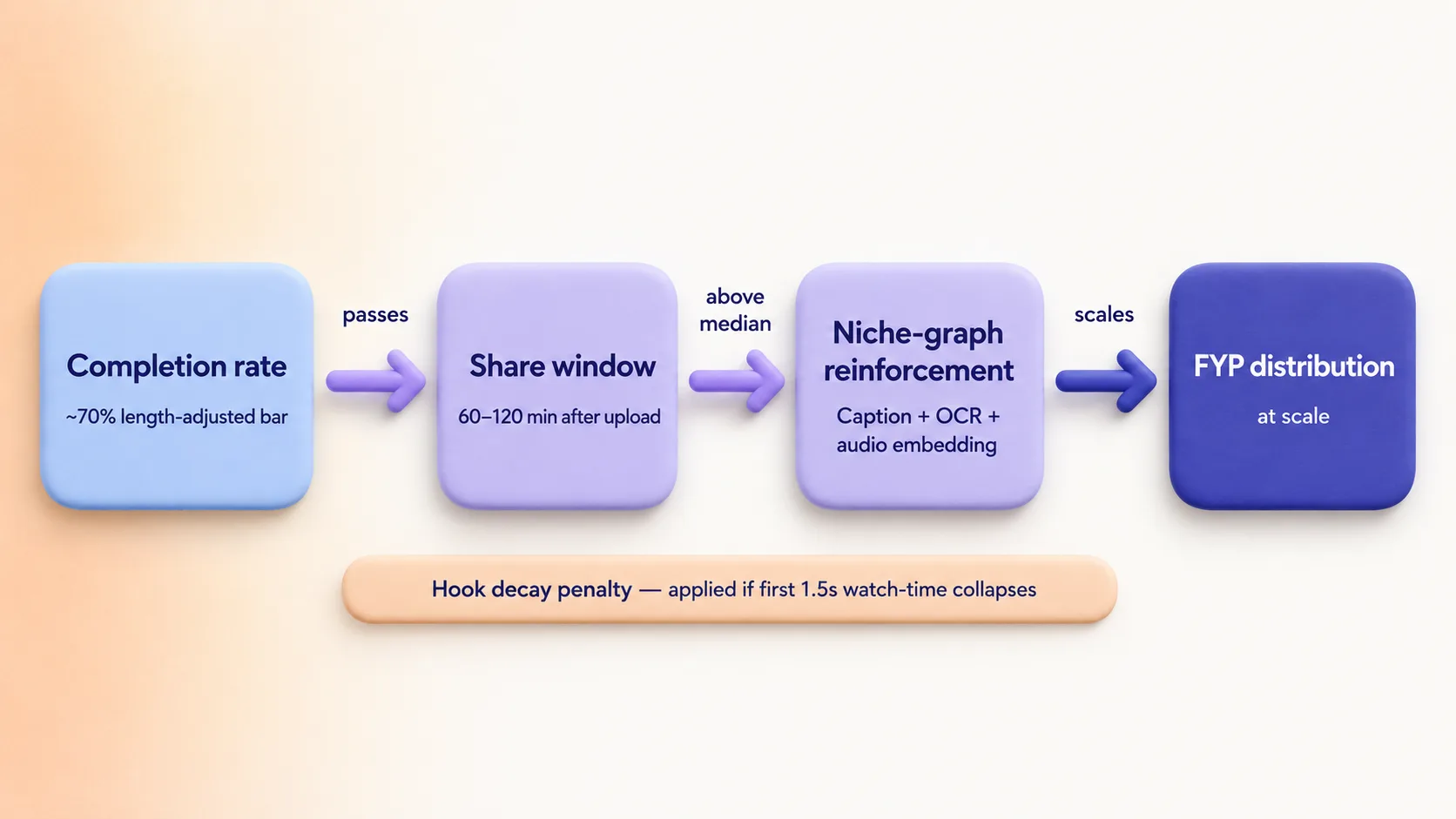
Completion rate is the highest-weighted signal. TikTok's public guidance and creator-economy reporting through early 2026 are consistent on this: the FYP tests new uploads against your followers first, then expands distribution only if early-cohort completion clears a high length-adjusted bar (creator-tool benchmarks put this near 70% in 2026, up from roughly 50% in 2024 — TikTok does not publish the exact threshold). A 17-second video at 88% completion outperforms a 60-second video with the same total watch time. Short videos punch above their weight, but only if they actually finish.
Share rate appears to weight above likes. A like is a tap. A share is a personal endorsement plus distribution into a private graph TikTok can't see directly. Save weight has also climbed: TikTok is turning into a search-and-reference platform, and saveable content (tutorials, checklists, comparisons) gets a structural boost.
The "hook decay" penalty is real. If watch time per impression on the first 1.5 seconds collapses, the algorithm flags the video and stops feeding it impressions. There's no recovery. A weak hook on a strong video kills the video. The hook window has functionally collapsed to under 2 seconds.
Niche-graph reinforcement. TikTok builds an embedding of your account from caption keywords, on-screen text OCR, audio transcripts, and visual style. Repeating those signals teaches the algorithm to push you into the right interest graph. Wandering across niches resets the embedding.
The "share window" signal. The first 60–120 minutes after upload appear to function as a shareability test. If the video gets shared above your account's median share rate during that window, distribution opens. If not, it caps and rarely reopens. This updates the older "first 90 minutes engagement" framing: engagement alone isn't enough; shares are the signal that matters.
Content-quality crackdown. TikTok is down-ranking watermark-heavy content (CapCut, AI-tool watermarks), low-effort reposts, and obvious mass-produced output. The "AI slop" filter is aggressive. The fix isn't avoiding AI; it's removing watermarks before upload, varying visual style enough to read as deliberate, and disclosing AI per TikTok's April 2026 policy.
The implication: build for hook + completion + cadence + share-bait + niche consistency.
Aspect ratios and the hidden safe zone
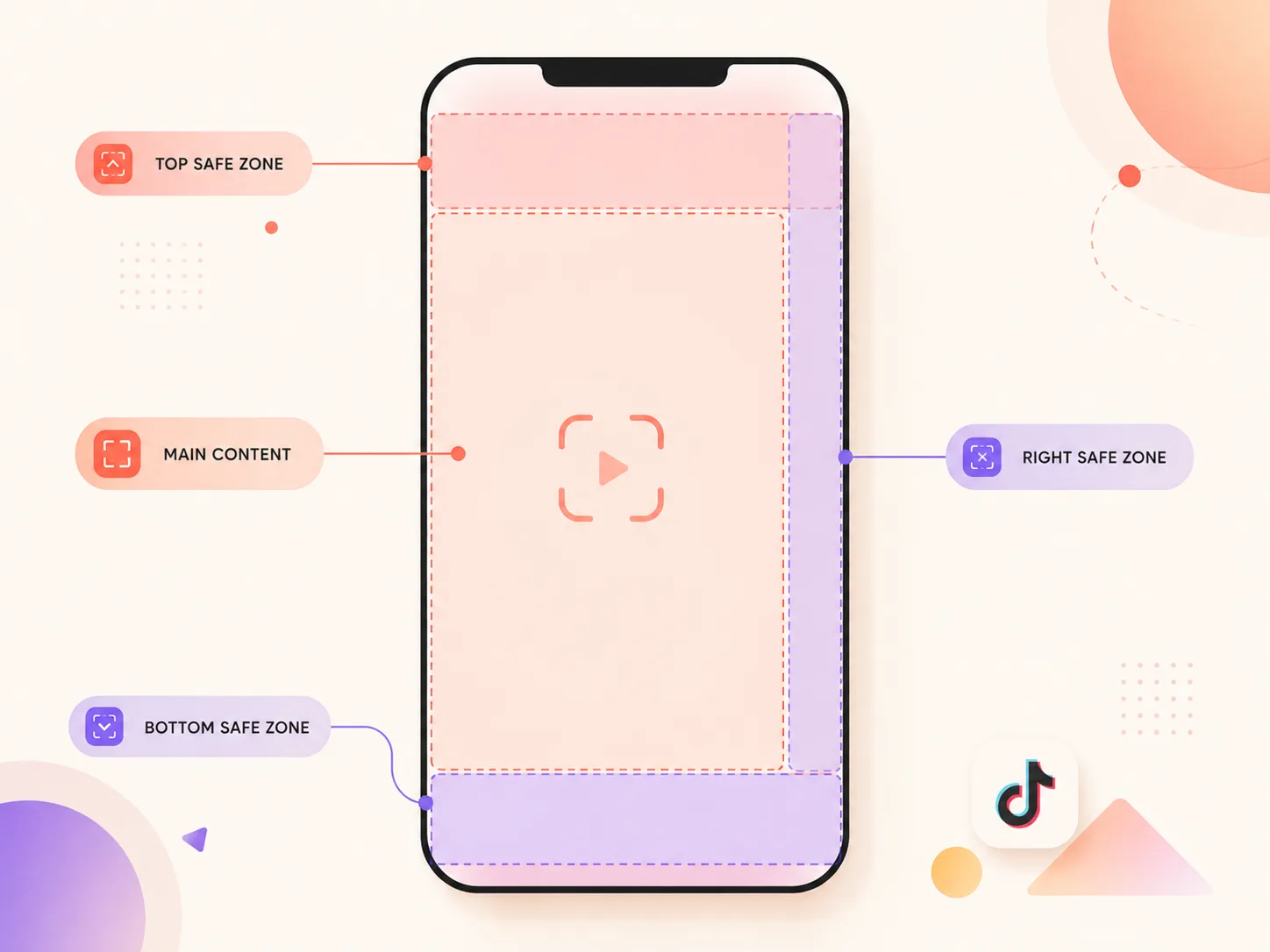
TikTok is 9:16 vertical only. What most accounts get wrong is the safe zone within that 9:16.
| Zone | Pixel range (1080×1920) | What lives here |
|---|---|---|
| Top 200px | 0–200 | Username/handle overlay |
| Bottom 320px | 1600–1920 | Caption, buttons, music attribution |
| Right 200px | 880–1080 | Like/comment/share buttons |
| Safe content area | 0–880 horizontal, 200–1600 vertical | Where your actual content lives |
Most AI-generated videos render full-frame and lose 30–40% of their visual hierarchy to TikTok UI overlays. The fix: generate at 9:16 but compose for the inset. Subjects in upper-middle, on-screen text between vertical pixels 250 and 1500. Lumigen and most 2026-era tools have a "TikTok-safe" preset that handles this. If your tool doesn't, you're shipping unfinished video.
11 hook patterns with example scripts
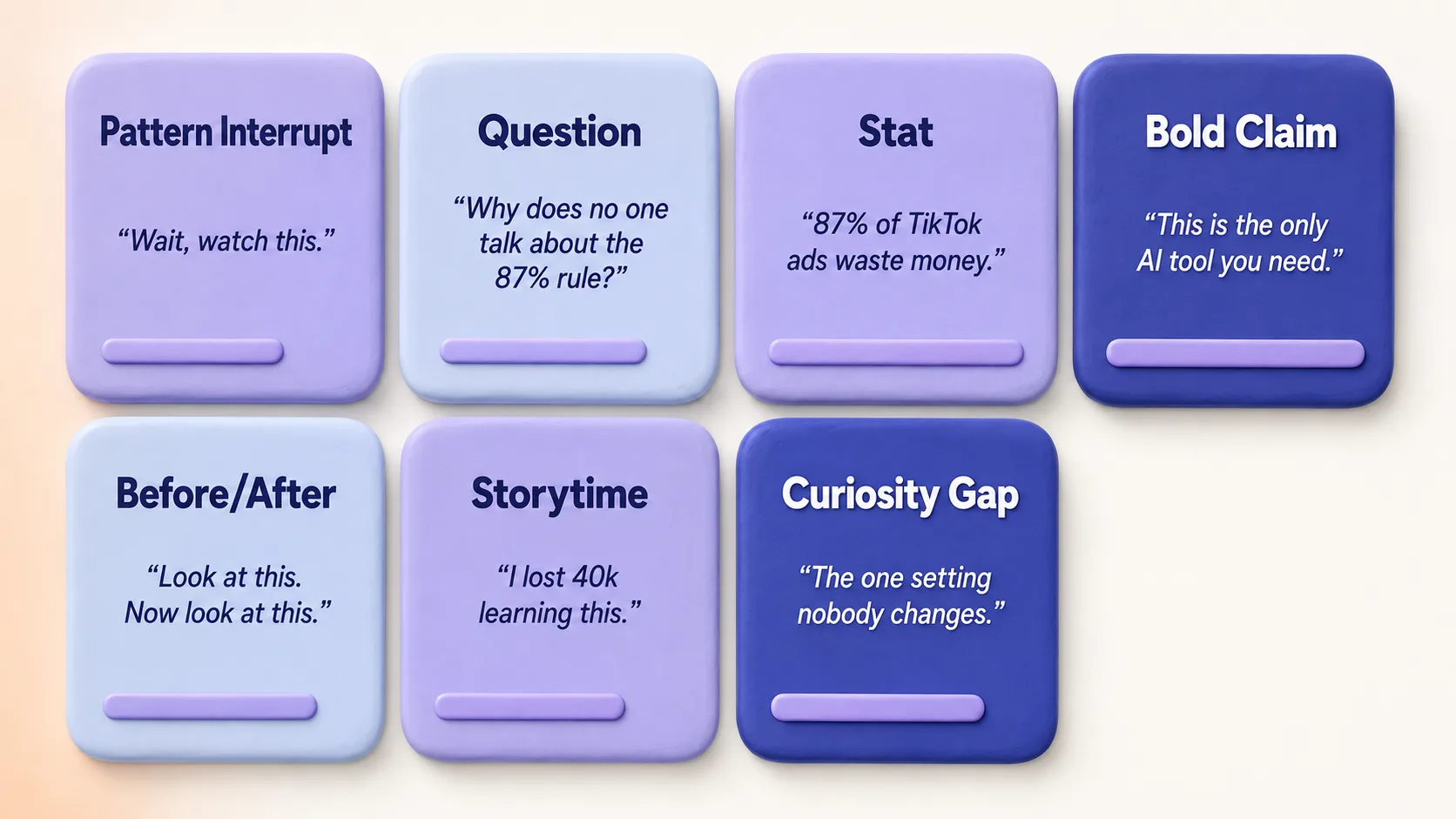
Hooks are 80% of the work on TikTok in 2026. The video is 20%. These are eleven hook patterns with 3–5 example openings each. Use them as scaffolding, not scripts.
1. Pattern interrupt
Pre-emptive interrupt to whatever the viewer was about to do (swipe). Visual jump, audio jump, deliberately incomplete sentence.
- "Wait, watch this. Most people miss it the first time."
- "Stop. You've been doing this wrong since Tuesday."
- "Hold on. This isn't the trick. This is the trick."
Why it retains: a flat opening reads as low-effort. An interrupt reads as "something is happening."
2. Question hook
A question the viewer wants answered but didn't know they did.
- "Why does no one talk about the 87% rule?"
- "Why does every AI video have the same weird color palette?"
- "Why does ChatGPT make this exact mistake every time?"
Why it retains: viewers' brains auto-complete questions. They want to test their guess against yours.
3. Stat hook
A specific, claimable number that creates an obligation to verify.
- "87% of small businesses spending money on TikTok ads are wasting it. Here's the test."
- "$847. That's what one prompt earned this account in the last 30 days."
- "47 AI tools tested. Only three are worth using."
Why it retains: specific weird numbers (87%, $847) read as research. Avoid round numbers ("100%", "1 million") — they read fake.
4. Bold claim
A confident assertion that frames your video as the definitive take.
- "This is the only AI tool you actually need."
- "The faceless TikTok strategy everyone is teaching is wrong."
- "If you're paying for Sora, you're overpaying."
Why it retains: confidence demands attention. Earn the claim — empty bold claims burn out, and the algorithm reads abandonment as hook decay.
5. Before/after tease
Outcome teased; work compressed into a curiosity gap.
- "Watched this for 6 hours, then made $400 the next morning."
- "Did this every day for 30 days. Results are not what I expected."
- "Posted 90 videos in 30 days. Here's what actually moved the needle."
Why it retains: outcome-first framing pulls viewers through to the work. Strong on completion.
6. Curiosity gap
You did the work; the viewer gets the answer.
- "I tested 47 AI tools so you don't have to. These are the only three worth paying for."
- "I read 600 viral TikTok captions. They all do this one thing."
- "Tried every faceless TikTok niche. Here's the one that actually pays."
Why it retains: synthesis without the labor. High save and share rates.
7. Direct address
Calling out a specific audience by identity, niche, or pain point.
- "If you're a Shopify seller, listen up. TikTok just changed how product videos rank."
- "Real estate agents, stop using stock footage."
- "Faceless TikTok creators, there's a new algorithm flag."
Why it retains: targeted hooks self-filter the audience. High completion among the matched cohort signals tight niche fit.
8. Counter-narrative
Framing your take as the opposite of what's circulating.
- "Stop buying followers. Do this instead. It's free and faster."
- "Stop posting at 7pm. That advice is two years old."
- "Posting 3x a day doesn't work anymore. Here's what does."
Why it retains: contrarian framing sets up a fight. The follow-through has to actually be different from consensus.
9. Numbered list tease
A specific count of items, teased as a list.
- "3 AI hacks that broke TikTok's algorithm last week."
- "5 prompts that turn ChatGPT into a viral hook generator."
- "10 mistakes I made in my first 100 videos so you don't."
Why it retains: lists create a structural promise. Viewers commit to all N items so they don't miss the last (which is usually framed as the most valuable).
10. POV / character
First-person framing as a character or moment.
- "POV: you finally figured out faceless TikTok."
- "POV: it's day 21 and your AI TikTok account just hit 100k followers."
- "POV: you cancelled your $400/month editor and replaced him with a $20 AI tool."
Why it retains: viewers send POV videos to friends as "this is literally me" content. Highest share-rate hook.
11. Reaction / trend hijack
Riding a sound, format, or current moment.
- Reaction to a trending sound: same sound, your niche's take.
- "Everyone is doing the trend name but for your niche."
- Hijacking a platform-wide moment (an outage, a celebrity post, a feature launch).
Why it retains: trend hijacks borrow the sound's existing distribution. Window is short (24–72 hours) but the lift is significant. Tools like Predis or TokBoost track trending sounds in your niche.

Trending format analysis
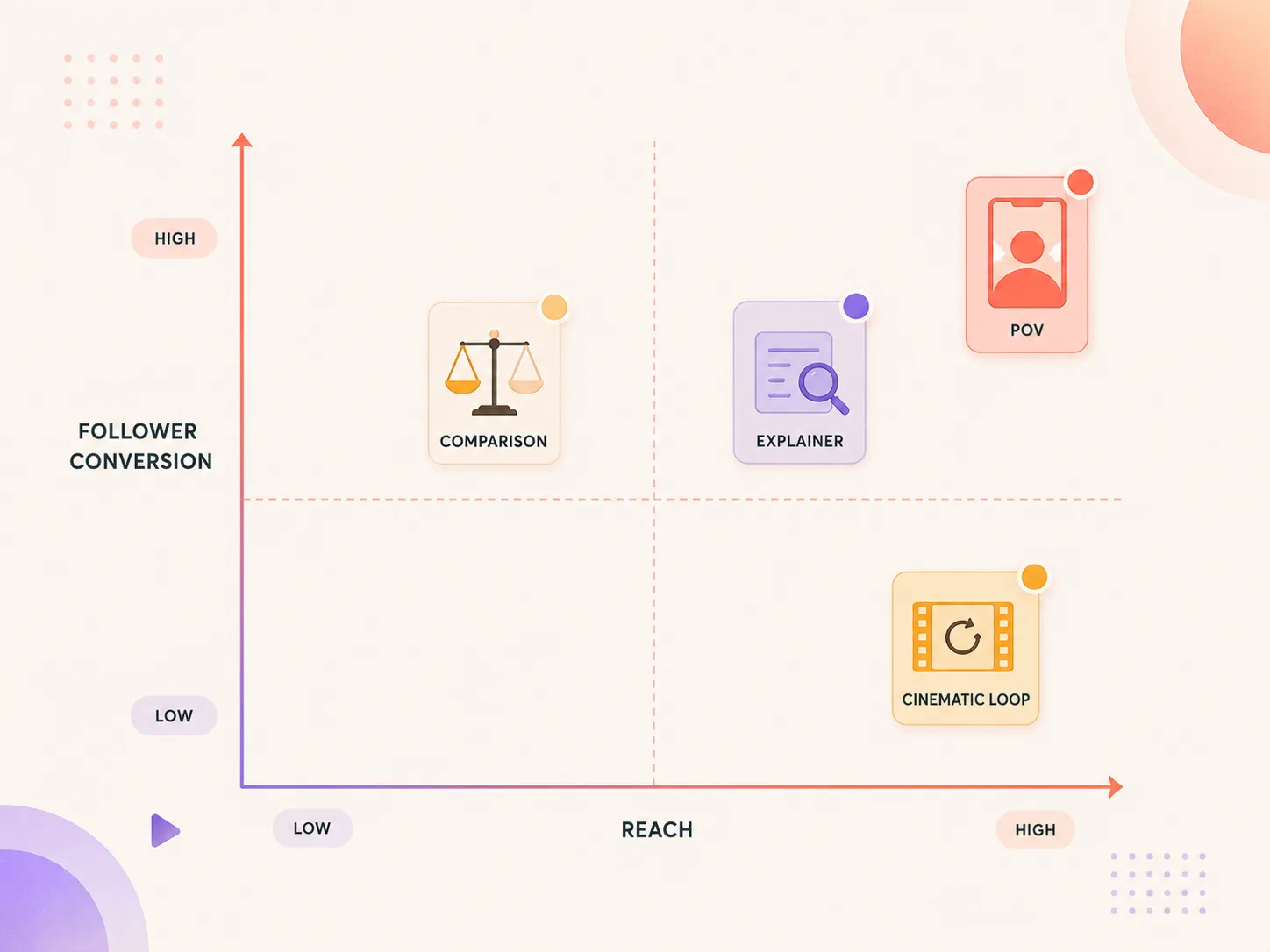
Format trends move fast on TikTok, but five meta-formats have been stable since late 2025 and will likely remain dominant through 2026. Pick the format that matches your goal (followers, reach, sales), not the one that's most popular.
Talking-head explainer (avatar + b-roll)
Presenter (real or AI avatar) speaks to camera, b-roll cuts in for visual reinforcement. Educational, business, tech, finance niches.
- Views: 8k–80k for new accounts; 50k–500k after niche-graph reinforcement
- Completion target: 65–75%
- Tool fit: HeyGen Avatar IV for the head, Lumigen or Veo 3.1 for b-roll, ElevenLabs for VO
- Hook match: stat, direct address, counter-narrative
- Strength: highest save rate of any format. Compounds over weeks.
- Breaks on: flat avatars without expression read as AI slop. Use Avatar IV+ tiers.
POV scenarios (Veo / Runway cinematic)
First-person scenario, 12–22s, cinematic AI visuals.
- Views: 50k–2M+ when it lands; 2k–10k when it doesn't (high variance)
- Completion target: 80–90% (these land hard or die)
- Tool fit: Veo 3.1 (audio-native default), Runway Gen-4 (stylized), Kling 2.1 (budget). Sora 2 via API works until Sept 24, 2026 but not a default for new pipelines.
- Hook match: POV, pattern interrupt, before/after
- Strength: highest single-video reach ceiling, strong shareability
- Breaks on: weak follower conversion. POV goes viral but rarely builds accounts; use for top-of-funnel reach, convert with explainer follow-ups.
Before/after transformations
Side-by-side or sequential reveal. Old vs new way.
- Views: 30k–400k per video
- Completion target: 75–85%
- Tool fit: any video generator + transition-heavy editor (CapCut, Submagic)
- Hook match: before/after tease, counter-narrative, bold claim
- Strength: highest completion rate of any format — viewers wait for the reveal
- Breaks on: synthetic stakes. Implausible before or implausible after kills trust.
Listicle countdown
"Top 5 X," numbered list with text overlay carrying most of the information.
- Views: 20k–200k
- Completion target: 70–80%
- Tool fit: Submagic, Crayo for split-screen, CapCut for native templates
- Hook match: numbered list tease, curiosity gap
- Strength: viewers commit to all N items; high save rate
- Breaks on: boring middle items. Front-load surprise.
Story-driven narrative (3-act structure in 60s)
Setup, conflict, resolution in 30–60s. Often "I tried X for 30 days" or "what happened when I."
- Views: 40k–800k (high variance)
- Completion target: 70–85%
- Tool fit: Lumigen + ElevenLabs. Consistent voice across acts.
- Hook match: before/after tease, curiosity gap, stat
- Strength: highest save and share rates when the value is genuine
- Breaks on: weak third act. Viewers feel cheated if the resolution is "subscribe."
| Format | Best length | Completion target | Strongest signal | Where it breaks |
|---|---|---|---|---|
| Talking-head explainer | 30–60s | 65–75% | Saves | AI-slop avatars |
| POV cinematic | 12–22s | 80–90% | Shares | Weak follower conversion |
| Before/after | 10–25s | 75–85% | Completion | Synthetic stakes |
| Listicle countdown | 18–35s | 70–80% | Saves + rewatches | Boring middle items |
| Story-driven narrative | 30–60s | 70–85% | Shares + saves | Weak third act |
POV is the highest-volume winner; explainers are the highest-retention; before/after is the highest single-video reach (but worst follower conversion). Pick the format that matches your goal.
Posting schedule and algorithm signals
The single biggest mistake new AI TikTok accounts make: posting once a day, "consistently for a few months," waiting for it to work. It does not work. Here's what does:
| Phase | Cadence | Duration | Goal |
|---|---|---|---|
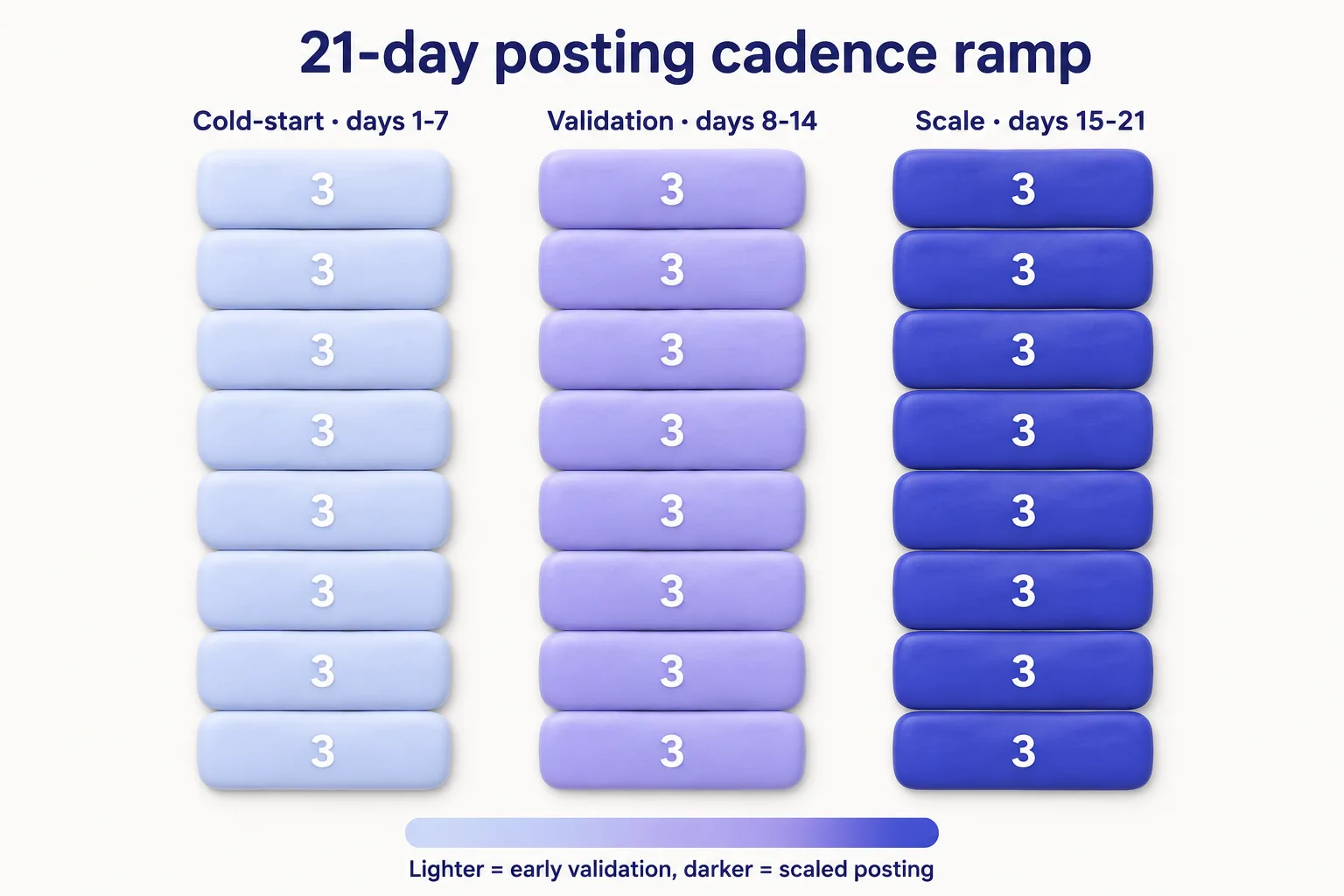
| Cold start | 3 videos/day | First 21 days | Force algorithm to read your content surface |
| Validation | 2 videos/day | Day 22–60 | Identify the format your account is best at |
| Scale | 1–2 videos/day | Day 60+ | Optimize for retention and conversion |
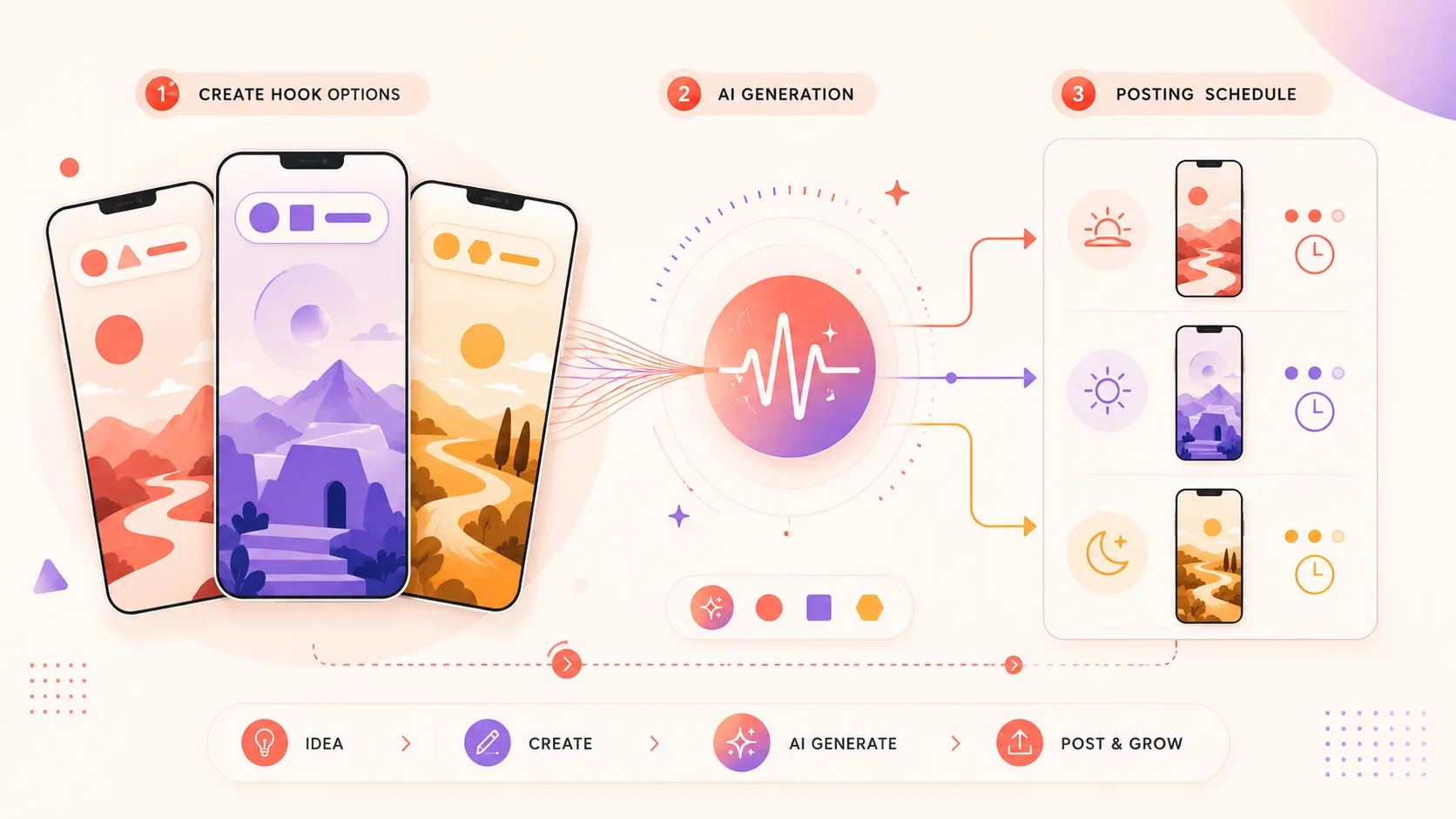
Three videos per day for the first three weeks is what unlocks the algorithm. It feels excessive. It's not. AI video tools made this volume sustainable for the first time. Pre-2024, this was a 12-hour-per-day production schedule. With a tool like Lumigen, you can prep three videos in under an hour.
The "best time to post" question
Post-2025 the FYP doesn't really care about time. It cares about hook quality. The "best time to post" advice surviving from 2022–2023 is mostly noise now. The algorithm distributes based on completion + share signals, not posting hour. A great hook posted at 3am will outperform a weak hook posted at 7pm.
That said, two windows still matter weakly: 11:30am–1:00pm ET (lunch scroll) and 6:30–9:00pm ET (evening scroll). Test all your time slots in week one. The "best time" is whichever your audience converts at, and that varies by niche more than people pretend.
The "first 90 minutes" myth vs reality
The old advice: "the first 90 minutes determine the video's reach." This was true in 2022. It's only half-true in 2026.
The 2026 reality: the first 60–120 minutes are a shareability test, not an engagement test. If your share rate clears the bar during that window, distribution opens. If shares are weak (even with high views and likes), distribution caps and rarely reopens.
The implication: optimize for shareability, not engagement. A video that 5,000 people watch and 50 share will outperform a video that 50,000 people watch and 100 share. Build hooks that prompt shares ("send this to a friend who…"), and structure the third act so it earns a re-tell.
The new "share window" signal
A 2026 addition: creator-economy reporting suggests TikTok now treats the share-to-impression ratio in the first 2 hours as a primary unlock signal. If your account's median share rate is 0.4% and your video clears 0.7%, distribution opens. If it sits at 0.3%, distribution caps. This appears to be account-relative; it scales to your baseline, so a small account with 50 shares on 1k impressions can unlock the algorithm faster than a large account with 200 shares on 100k.
The fix: don't assume "more views = more shares." Build for the share itself. Hooks 5 (before/after), 10 (POV), and 11 (trend hijack) have the highest share-rate-per-view in our internal sample.
Content series and niche planning
Series outperform one-offs by 4–8x in our sample of AI-driven accounts that hit 100k+ followers in 2026. The reason is structural: TikTok wants to know what your account is, and a series teaches the algorithm faster than scattered individual videos.
Why series win
A series — same character, same format, same niche, same opening pattern — teaches the algorithm three things at once: what topic graph you belong to, what your retention curve looks like, what your audience profile looks like. Scattered one-offs teach none of these. The algorithm re-learns your account on every upload.
In our sample: accounts running a series on at least 60% of their content reached 10k followers in a median 38 days. Scattered accounts took a median 124 days. Same cadence, same niche, different account-level signals.
The 30-video sprint method
- Pick one niche, one format, one hook style. Resist "testing multiple things." Testing simultaneously teaches the algorithm nothing.
- Plan 30 video concepts in one sitting. All 30 fit a single sentence: "videos about niche in format using hook style."
- Generate in batches. Three sessions of 10 each is more efficient than 30 separate sessions.
- Post 3/day for 10 days. If you skip, you reset the niche-graph signal.
- Day 10, evaluate. Top 3 by completion rate are your formats. Bottom 10 are noise.
- Second 30-sprint with refined formats. This is where accounts compound 0 → 50k.
Niche-graph reinforcement in practice
Five things you can repeat to teach the algorithm what you are:
- Same caption keyword family. Pick 8–12 keywords that appear in every caption.
- Same on-screen text style. Same font, same size, same position. The algorithm OCRs the frame.
- Same audio voice. ElevenLabs or one specific creator voice across all videos. Voice fingerprinting is a real algorithm signal.
- Same visual style. Same color grade, same opening transition, same end-frame loop.
- Same posting cadence pattern. 3/day at consistent intervals teaches the algorithm an upload rhythm.
This is the boring work. It is also where the lift comes from.
Faceless niche selection
If you're starting from scratch, the highest-RPM niches in 2026 are personal finance, education/how-to, business/SaaS, true crime, animated storytelling, and tech reviews. Personal finance and tech currently sit at $1.00–$2.00+ per 1k qualified views on the Creator Rewards Program, vs $0.30–$0.60 for entertainment and dance. Niche-graph reinforcement is also stronger in these niches because keywords are tight (no one searches "lifestyle," but plenty of people search "tax write-offs").
For a deeper niche playbook applied to YouTube Shorts (much of which transfers), see the faceless YouTube channel guide.
FYP optimization
Once you have hooks, format, and cadence, four levers raise the ceiling on every individual video.
Captions strategy
Captions are now search-optimized text, not afterthoughts. TikTok's 2026 search index reads your caption first and the on-screen text OCR second. The optimal caption: 1–2 sentences, primary keyword in the first 4 words, emotional hook in the second sentence, 3–5 niche-specific hashtags appended.
Bad: "New video! 🔥 #fyp #viral" Good: "How AI cuts TikTok production from 4 hours to 12 minutes (the 3-tool stack). Most accounts overthink this. #aitiktok #facelesscreator #tiktoktools"
Hashtag math
The 2023 advice was "more hashtags = more reach." This is wrong now. The 2026 reality: 3–5 niche-specific hashtags + 1 broad hashtag is the optimum. More than 5 is read as spam. Fewer than 3 underspecifies your niche-graph signal.
Niche-specific hashtags should have 100k–10M total uses (specific enough to compete in, broad enough to have an audience). Avoid hashtags above 50M uses; you're invisible there.
Sound choice
Trending sounds borrow distribution. Original audio builds it. The hybrid: use a trending sound for the first 30 days to ride the boost, then transition to original audio (ElevenLabs voiceover counts as original) once your account has a niche signal.
A trending sound in 2026 has an effective lift window of 24–72 hours from the time it starts trending. Tools like TokBoost or Predis surface trending sounds in your niche. After 72 hours the sound is saturated and the lift inverts (everyone uses it; the algorithm starts reading it as low-effort).
Text overlay readability
The TikTok caption overlay area (bottom 320px) is where most accounts put their on-screen text. This is wrong. The bottom 320px is occluded by the platform's own caption overlay on most viewers' screens.
Put your on-screen text in the upper-middle (vertical pixels 250–800), font size at minimum 60pt for the main hook text, contrasting outline or shadow on every character. Test on a phone with the platform UI active, not on your editor's preview.
End-frame loop trick
If the last frame visually matches the first frame, viewers loop the video involuntarily. The algorithm reads loops as completion-rate boosts. The trick: end the video on the same composition as the opening, then cut to black for one frame.
A 14-second video that loops once becomes a 28-second view. A 14-second video that loops three times becomes 56 seconds. The algorithm sees this as a 4x completion rate.
Monetization paths
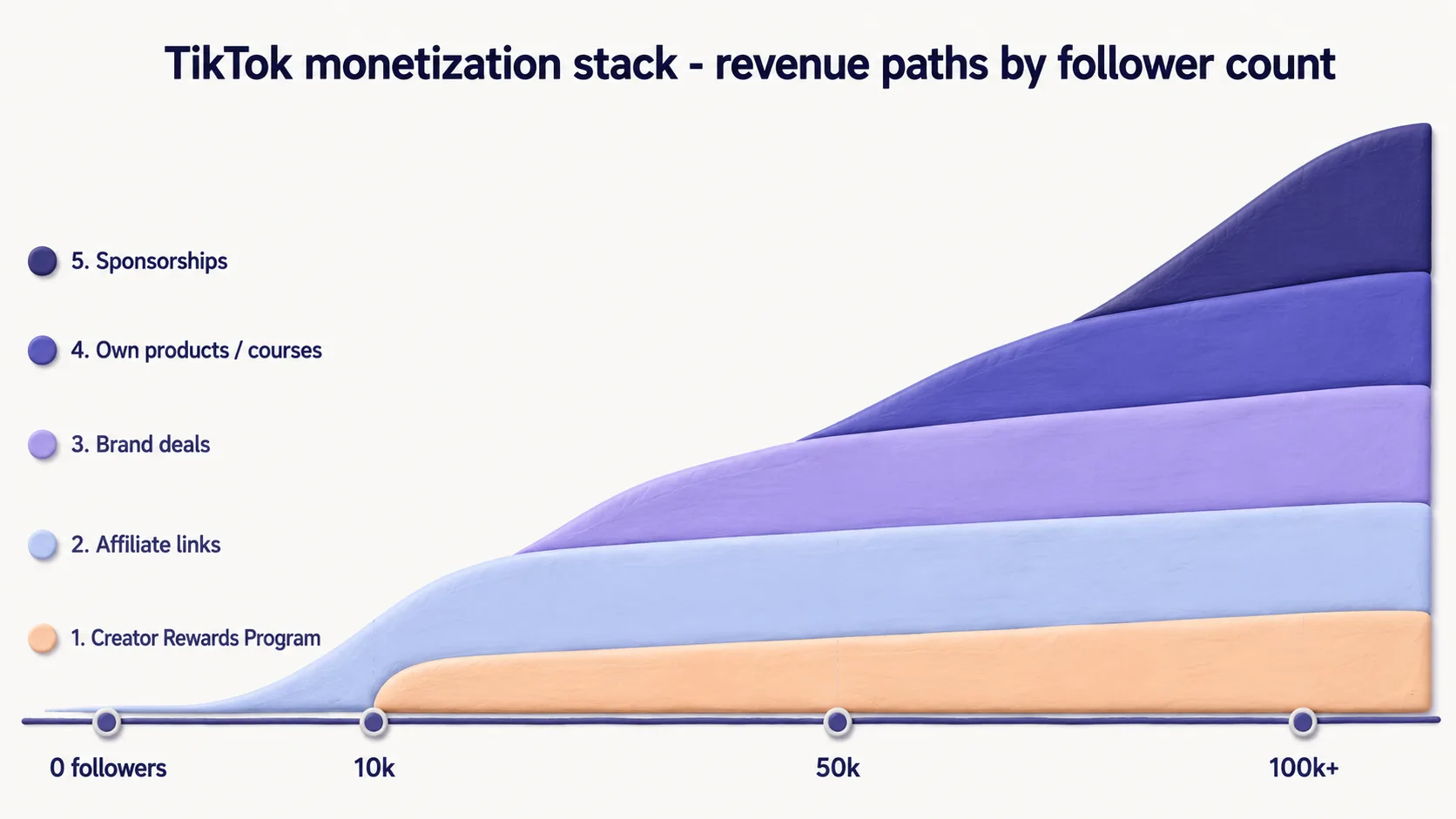
The Creator Rewards Program is one of five real income streams. Here's the actual math, not the optimistic version.
Creator Rewards Program (formerly Creativity Program / Creator Fund)
Eligibility: 10k+ followers, 100k+ views in the last 30 days, age 18+, personal account, US/UK/Germany/France/Japan/South Korea/Mexico/Brazil. Videos must be 1+ minute. A "qualified view" requires 5+ seconds of watch.
Payouts as of mid-2026:
- Entertainment / dance / vlogs: $0.30–$0.60 per 1k qualified views
- Educational / how-to: $0.60–$1.00 per 1k
- Finance / tech / business: $1.00–$2.00+ per 1k
- Top-performing content: up to $6.00 per 1k
Min withdrawal $50, pays the 15th. Tier 1 countries earn 2–5x more than Tier 2. The honest read: meaningful at 1M+ qualified views/month, side income below that. Don't optimize your strategy around it.
Brand deals
2026 benchmark: $0.005–$0.02 per follower per branded video. A 50k-follower tech account can charge $250–$1,000 per branded post. A 50k-follower dance account might charge $150–$300.
Brand deals are the highest-leverage income above 25k followers in a high-RPM niche. Three branded posts per month at $400 = $1,200/month from a 50k account, well above what the Creator Rewards Program pays at the same audience size.
Affiliate (TikTok Shop)
TikTok Shop commissions range 5–20% by category. Beauty/fashion 8–15%; tech and digital products vary up to 30%. Catch: requires US/UK/SEA presence and a 90-day approval process.
Non-Shop affiliate: drive traffic to a link-in-bio service (Beacons, Linktree, Stan Store) with affiliate links. CTRs from TikTok bio sit at 1.5–4% for genuine niche fit. 100k uniques × 2.5% CTR × 5% conversion × $15 commission = $1,875 per video.
Off-platform funnel (SaaS, newsletter, course)
Highest-ROI path for technical and educational niches. Bio link CTR 1.5–4%; newsletter conversion 8–15% on niche-fit content; SaaS sign-up conversion 1–4%.
200k uniques/month × 2.5% bio CTR × 12% newsletter conversion = 600 new subscribers/month. At $4–$10 LTV per subscriber, that's $2,400–$6,000/month indirect, on top of direct revenue.
If you run a SaaS, the AI video ads ecommerce playbook covers the organic-to-paid amplification flow.
Course / coaching funnel
Highest revenue per converted view. A $97 course at 0.3% conversion from a 500k-view video is $1,455. A $497 course at the same rate is $7,455. The catch: requires a real product, testimonials, and a converting sales page. Months of work upstream.
| Path | Required followers | Revenue/month at 50k followers | Effort to set up |
|---|---|---|---|
| Creator Rewards | 10k+ (high-RPM niche) | $50–$400 | Low |
| Brand deals | 25k+ (any niche, tech/finance pays more) | $400–$3,000 | Medium |
| Affiliate (TikTok Shop) | None, but Shop approval | $200–$2,500 | Medium |
| Newsletter / SaaS funnel | None — pre-product helps | $1,000–$6,000 (indirect) | High |
| Course / coaching | 25k+ (engaged niche) | $1,500–$15,000 | Very high |
AI tools for TikTok in 2026
The current stack. Pricing as of May 2026; check the source month and verify before committing. Pricing on this category moves quarterly.
Lumigen
Vertical-native by default. The output preset starts at 9:16 with the safe-zone overlay built in, which is the only AI video tool we've used where TikTok-formatted output is the default rather than an afterthought. Strong on cinematic POV and short narrative. Lumigen is the in-house tool; we use it daily and the bias is real — see the AI video generators comparison for the broader landscape.
- Best for: cinematic POV, short narrative, talking-head + b-roll
- Vertical native: yes (9:16 default)
- Cost: starts around $30–$40/month
Submagic
Captions and b-roll specialist. The fastest way to add platform-native captions to AI-generated video. Strong AI-driven b-roll suggestion engine.
- Best for: caption-heavy listicles, talking-head augmentation
- Vertical native: yes
- Cost: around $20–$50/month depending on plan
Crayo
Split-screen specialist, often used for the reddit-story-on-top, gameplay-on-bottom format. Strong in entertainment/storytelling niches.
- Best for: split-screen narrative, story-driven content
- Vertical native: yes
- Cost: around $25–$40/month
CapCut (with AI features)
Free editor with native TikTok ownership (ByteDance owns both). Strong template library, AI auto-cut, AI captions. The single most-used editor on TikTok.
- Best for: editing AI-generated footage into final post
- Vertical native: yes (TikTok-aware presets)
- Cost: free; CapCut Pro around $7.99/month
Veo 3.1
Google's audio-native model: generates synchronized audio with video, which is unique in the category. Strong on dialogue scenes (still imperfect), ambient soundscapes, talking-head adjacent content. After Sora 2's April 2026 shutdown, this is the default cinematic-quality pick.
- Best for: cinematic POV, audio-native scenes, when audio matters as much as video
- Vertical native: yes
- Cost: per-generation via Vertex AI or Lumigen
Sora 2 (discontinued)
OpenAI's flagship cinematic model from 2025. Strong on POV, atmospheric scenes, surreal narrative. The Sora consumer app shut down April 26, 2026 and the API closes September 24, 2026 — keep it out of new pipelines and migrate any Sora-dependent flows to Veo 3.1 or Runway Gen-4 before the cutoff.
- Best for (historical): cinematic POV reach plays through Sept 2026
- Cost: API only, ~$0.50–$2/short, until Sept 24, 2026 cutoff
HeyGen
Avatar-driven talking-head video. Avatar IV achieves around 0.02s lip-sync accuracy, which is the threshold where vertical close-ups stop reading as obviously AI. Best for educational and business niches that need a presenter.
- Best for: talking-head explainer
- Vertical native: yes
- Cost: starts around $24/month for limited generations; Pro/business tiers higher
For broader avatar comparisons, see the Synthesia alternatives breakdown — HeyGen is one option in a crowded field.
For model-level comparisons (Sora vs Veo vs Runway vs Kling) on the cinematic side, the four-way comparison covers strengths per use case.
| Tool | Vertical native | Best for | Approx. cost/month |
|---|---|---|---|
| Lumigen | Yes | Cinematic POV, narrative, talking-head + b-roll | $39–$69 |
| Submagic | Yes | Captions, b-roll for listicles | $20–$50 |
| Crayo | Yes | Split-screen storytelling | $25–$40 |
| CapCut | Yes | Editing, templates | $0–$8 |
| Veo 3.1 | Yes (preset) | Audio-native scenes, cinematic POV | per-gen via Vertex/Lumigen |
| Sora 2 (sunsets Sept 2026) | Yes (preset) | Historical / API window only | API only, ~$0.50–$2/short |
| HeyGen | Yes | Talking-head explainer | $24+ |
A reasonable starting stack: Lumigen Starter + CapCut + ElevenLabs ≈ $51/month. Add HeyGen if you need a presenter. Add Submagic if you do listicles.
10 template breakdowns with full scripts
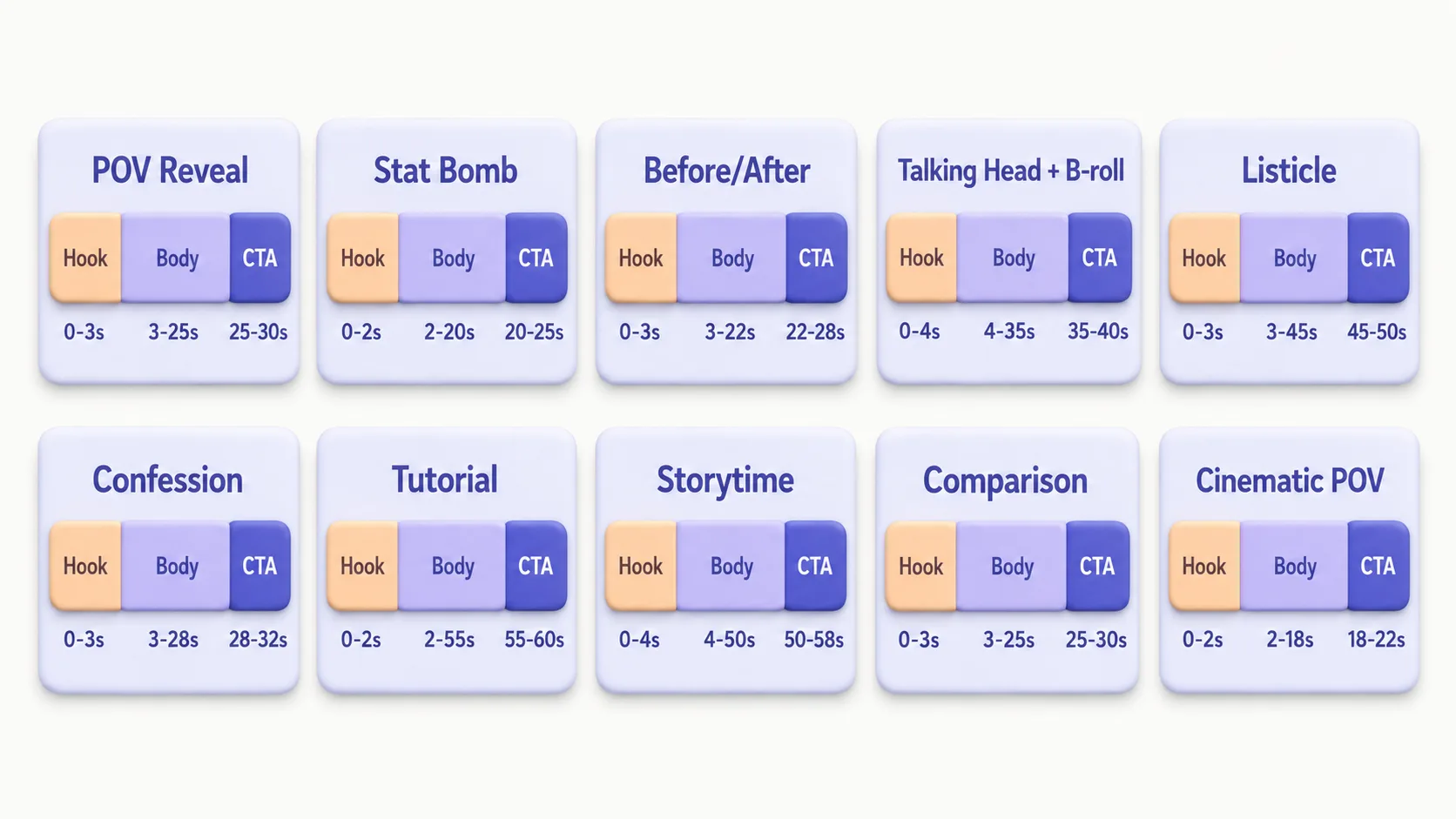
Ten complete templates with hook (3s), body (10–30s), and CTA (3–5s). Use them as scaffolding for your own variants.
Template 1: "I tried trend/tool for 30 days"
0–3s    HOOK (before/after tease):
        "I tried using [tool] every day for 30 days. The results are not what I expected."
3–25s   BODY: Day 1 result (low expectation), week 2 turning point,
        day 30 outcome with specific number ($/views/followers).
25–28s  CTA: "Doing this with [tool 2] next month. Follow for results."
Best length: 28–35s. Best format: talking-head + b-roll. Hook strength: high; landing weight on the day-30 outcome.
Template 2: "POV: you discovered insight"
0–2s    HOOK (POV / character):
        "POV: you finally figured out [insight]."
2–14s   BODY: First-person scenario showing the insight in action.
        Cinematic AI-generated visuals support, voiceover or text overlay carries.
14–18s  RESOLUTION: the moment that makes the scenario satisfying.
        Loop back to opening frame.
Best length: 16–20s. Best format: POV cinematic. Hook strength: very high on share rate.
Template 3: "Top 3 AI tools for niche"
0–3s    HOOK (numbered list tease):
        "3 AI tools that are quietly running the [niche] meta right now."
3–8s    Tool 1: 5s screen recording + on-screen name + use case
8–14s   Tool 2: same structure
14–22s  Tool 3 (the "best" one — front-load the surprise here):
        more time, more detail.
22–25s  CTA: "Saving this — comment which one you're trying first."
Best length: 22–28s. Best format: listicle countdown. Hook strength: high on save rate.
Template 4: "Don't buy popular thing until you watch this"
0–3s    HOOK (counter-narrative):
        "Don't buy [popular thing] until you've watched this."
3–14s   BODY: the hidden flaw / better alternative / common mistake.
        Specific number that justifies the claim.
14–22s  PROOF: side-by-side screenshot, specific feature comparison.
22–25s  CTA: "Tag someone about to buy [thing]."
Best length: 22–28s. Best format: before/after or listicle. Hook strength: very high on shares (tag mechanic).
Template 5: "How I made outcome with AI"
0–3s    HOOK (stat hook):
        "$847. That's what AI made this account in the last 30 days. Here's how."
3–10s   STEP 1: tool + prompt + result (specific).
10–18s  STEP 2: the unexpected leverage point.
18–25s  RESULT: the specific outcome with proof.
25–28s  CTA: "Free script template in bio."
Best length: 25–30s. Best format: story-driven narrative. Hook strength: highest on bio CTR.
Template 6: "AI vs human task"
0–3s    HOOK (bold claim):
        "AI vs a $200/hour [profession]. The result wasn't close."
3–12s   AI side: prompt + output, time elapsed.
12–22s  Human side: process + output, time elapsed.
22–28s  VERDICT: the side that won, with the specific reason.
        Honest if AI lost.
Best length: 26–32s. Best format: before/after. Hook strength: very high on completion (viewers wait for verdict).
Template 7: "What audience gets wrong about topic"
0–3s    HOOK (direct address + counter-narrative):
        "What [audience] gets wrong about [topic]."
3–10s   The wrong belief: what most people think.
10–22s  The correct framing: what's actually true, with specific example.
22–28s  CTA: "Share this with someone still doing it the old way."
Best length: 25–30s. Best format: talking-head explainer. Hook strength: high on save rate.
Template 8: "Reaction to trend / drama"
0–3s    HOOK (pattern interrupt):
        "Wait, you saw the [trend / drama] today, right?"
3–8s    Context: the trend, in 5 seconds.
8–22s   Your take: contrarian or insightful angle, niche-specific.
22–25s  CTA: "Following for more [niche] takes."
Best length: 22–26s. Best format: talking-head. Time-sensitive — post within 24h of the trend.
Template 9: "Day in the life of profession + AI angle"
0–3s    HOOK (curiosity gap / POV):
        "Day in the life of an AI [profession] making $[number]/month."
3–8s    Morning: tool + first task + visual.
8–16s   Midday: the leverage moment (where AI compresses 4 hours into 20 minutes).
16–24s  Evening: the result, the dollars, or the freed time.
24–28s  CTA: "Tools in bio."
Best length: 26–32s. Best format: story-driven. Hook strength: very high on follower conversion (lifestyle aspiration).
Template 10: "Faceless TikTok niche walkthrough"
0–3s    HOOK (curiosity gap):
        "I tested [N] faceless TikTok niches. Only [M] are worth it in 2026."
3–8s    Niche 1 (eliminate): why it doesn't work now.
8–14s   Niche 2 (eliminate): why it doesn't work now.
14–25s  Niche 3 (the winner): why it works, RPM, follower-growth math.
25–28s  CTA: "Free niche checklist link in bio."
Best length: 26–32s. Best format: listicle countdown. Hook strength: very high on save + bio CTR.
For prompt patterns specifically tuned for short-form vertical content, the AI video prompts guide has dedicated TikTok and Reels prompt sections.
The production pipeline
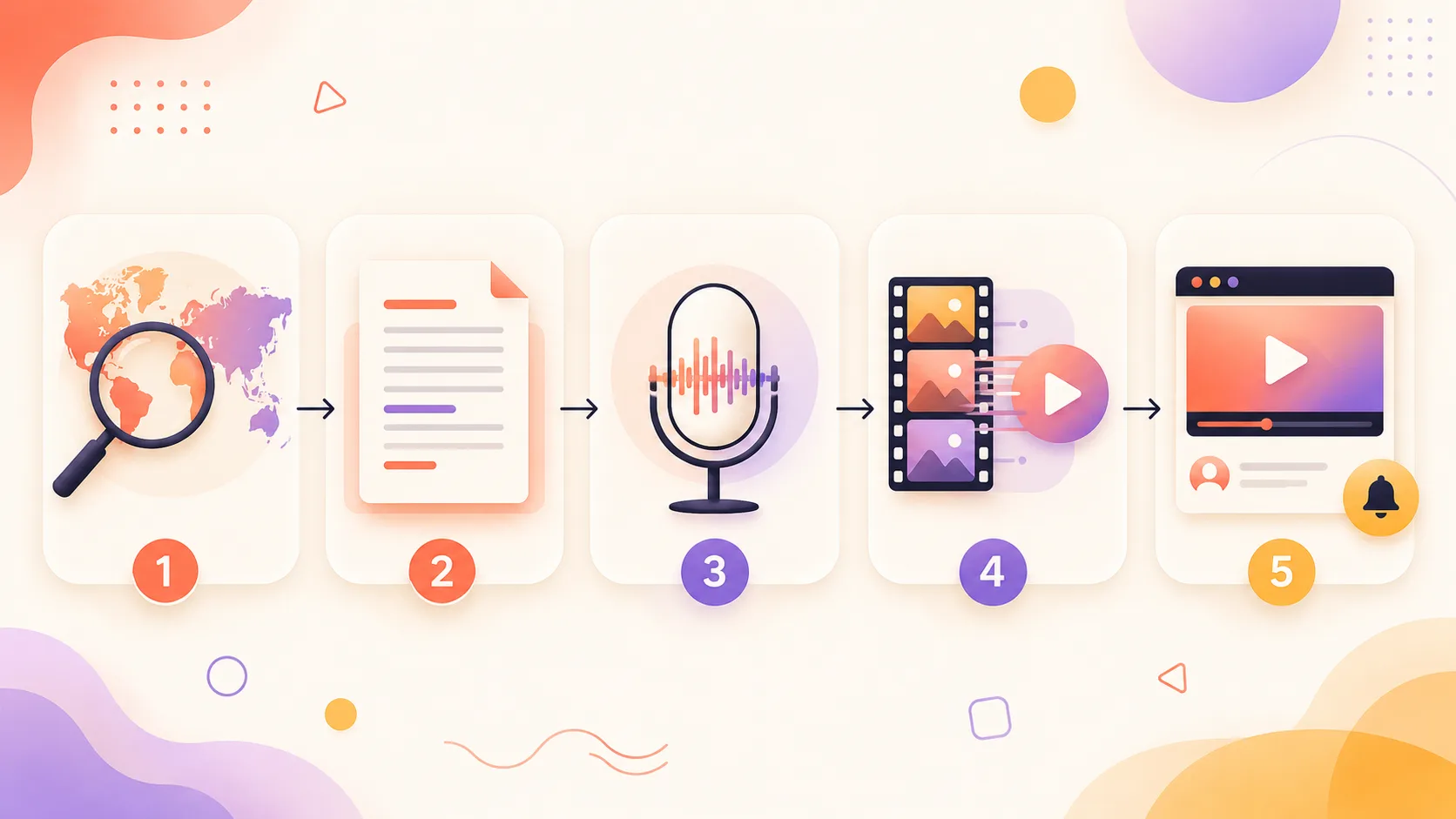
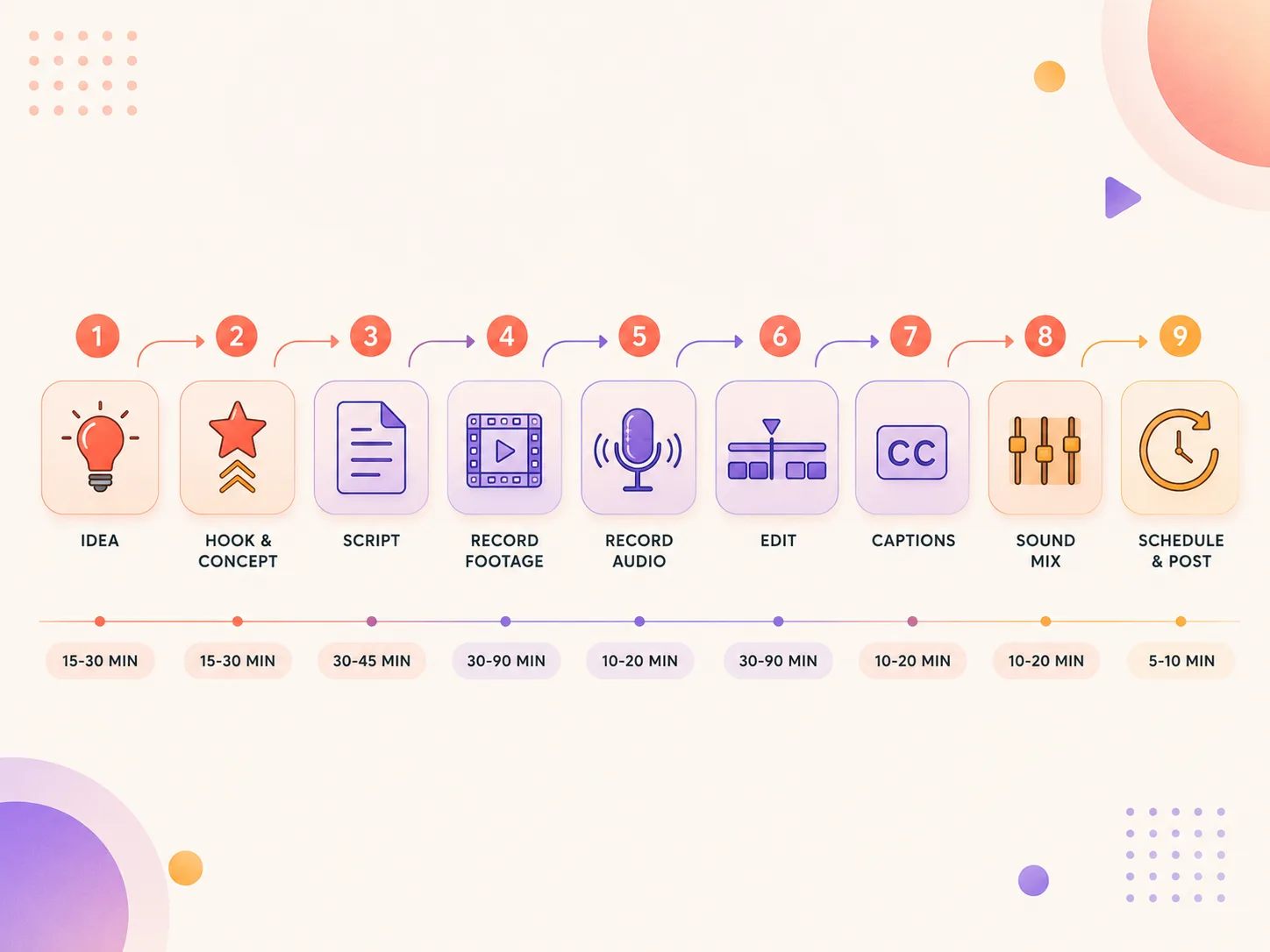
A pipeline that ships 3 videos per day:
- Idea capture — running document of hooks and concepts. Add daily, not when you sit down to film.
- Hook generation — 5 variants per idea, pick one, throw out the rest.
- Script writing — 30–80 words. Voiceover, on-screen text, visual cues.
- Visual generation — Lumigen, Veo 3.1, Runway Gen-4, or Kling — chosen by visual style. (Sora 2 still works via API until Sept 24, 2026.)
- Voiceover — ElevenLabs or OpenAI TTS. Same voice across the account.
- Assembly — vertical timeline in CapCut, Lumigen's editor, or Descript. Cut hard on motion.
- Captions — auto-generated, human review. AI captions still mis-cap brand names.
- Audio mix — music at -16 LUFS, voiceover at -10 LUFS. Separates pro from amateur output.
- Upload — TikTok's native scheduler or Metricool. Native ranks slightly better.
End-to-end: 12–22 minutes per video. For 3/day, that's about an hour of work, six days a week.
Common TikTok mistakes
The repeating list of things that kill AI TikTok accounts.
Wrong aspect ratio. Rendering at 16:9 or 1:1 and uploading. TikTok crops aggressively, and the crop never picks the right region. Render at 1080×1920 native, not 1920×1080 with auto-crop.
Captions too small. Default font sizes from desktop editors look fine on the editor preview and unreadable on a phone. Minimum 60pt, contrasting outline. Test on actual mobile.
Hook too slow. Three seconds of intro music before the first word is dead air. Swipe rate during those 3 seconds will tank the video. Open with the hook in frame 1.
Ignoring platform-native sounds. Original audio is fine, but a fully unboosted account benefits from trending sound usage in the first 30 days. The lift is real, even if the long-term value is lower than original audio.
Posting and ghosting. Posting then disappearing for 4 hours kills account-level engagement signals. The first 30 minutes after upload, reply to early comments. The algorithm reads your activity in your own comments as engagement signal too.
Shadowban triggers. The most common shadowban triggers in 2026: external link spam in captions, repeated identical hashtag sets, watermarked AI tool output (CapCut watermark, Sora watermark), and undisclosed AI content per TikTok's April 2026 disclosure policy. The fix on the last one: toggle "AI-generated content" in the upload settings on any video using realistic AI visuals or voices. Failing to disclose is a distribution penalty.
Wandering across niches. "Today I'm doing a different topic for fun" resets the niche-graph signal. The algorithm starts re-classifying your account from scratch. Stick to one lane for at least the first 90 days.
FAQ
Where AI TikTok still doesn't work well
Honest tradeoffs:
- Reaction content. Taste tests, listening to music, opening packages — anything where the value is a real person's reaction does not translate. AI output reads performative, not authentic.
- Multi-person dialogue. Two or more characters in conversation is still the weakest output. Use single-character POVs or talking-head avatars.
- Ongoing narrative across videos. Multi-character story arcs require visual consistency AI models can't deliver reliably across sessions. Same-character series (one persistent avatar) work; continuing multi-character storylines do not.
- Genuinely funny content. Models produce competent jokes, rarely surprising ones. Your humor will out-perform AI-generated humor for the foreseeable future.
- Trend-specific dance and physical performance. AI renders bodies in motion, but the timing of a viral dance is human-coded.
The pattern: AI handles volume and visuals. Humans still handle taste and timing.
What we'd do this week
If you're starting from scratch:
- Pick a niche. Something specific enough that you can write 90 hooks about it without burning out. Personal finance, AI tools, real estate, parenting hacks, fitness for over-40s — all tight enough to generate a niche signal.
- Write 21 hooks today. Three per day for a week, in advance, all of them. Use the 11 hook patterns above as scaffolds.
- Generate the first 5 videos. Use templates 1, 3, and 5, mixed.
- Set up the tool stack. Lumigen + CapCut + ElevenLabs is a $50/month starting point. Add HeyGen if you need a presenter; add Submagic if you're doing listicles.
- Post day 1, twice. 11:30am and 7:00pm ET, see which performs better. Reply to every comment within 30 minutes.
- Hold 3-per-day cadence for 21 straight days. No exceptions, no "I'll catch up tomorrow." If you skip, the niche-graph signal resets.
- Evaluate at day 21. Your best two formats by completion rate are your formats. Drop the rest.
- Run a second 30-video sprint at day 22–35 with refined hooks on the top two formats. This is where accounts compound from 0 → 50k followers.
The accounts that went from 0 to 100k followers in Q1 2026 didn't post better videos. They posted more videos for longer than the people they were competing with. The pipeline above makes that volume possible. The discipline is on you.
If you want a tool that ships TikTok-formatted vertical video out of the box with the safe-zone preset already wired in, Lumigen handles that path. Or start with the beginner guide if you've never made an AI video before.
Same prompt.
Four models.
One project.
Sora 2, Veo 3.1, Runway Gen-4, Kling 3.0 — side by side, with a free tier that's actually useful for evaluation. Three videos at full quality, no watermark, no minute cap.

Vlad
Founder of Lumigen. Has shipped tens of thousands of generations across Sora 2, Veo 3.1, Runway Gen-4, and Kling 3.0 — and edits everything published here against that hands-on test bed.