
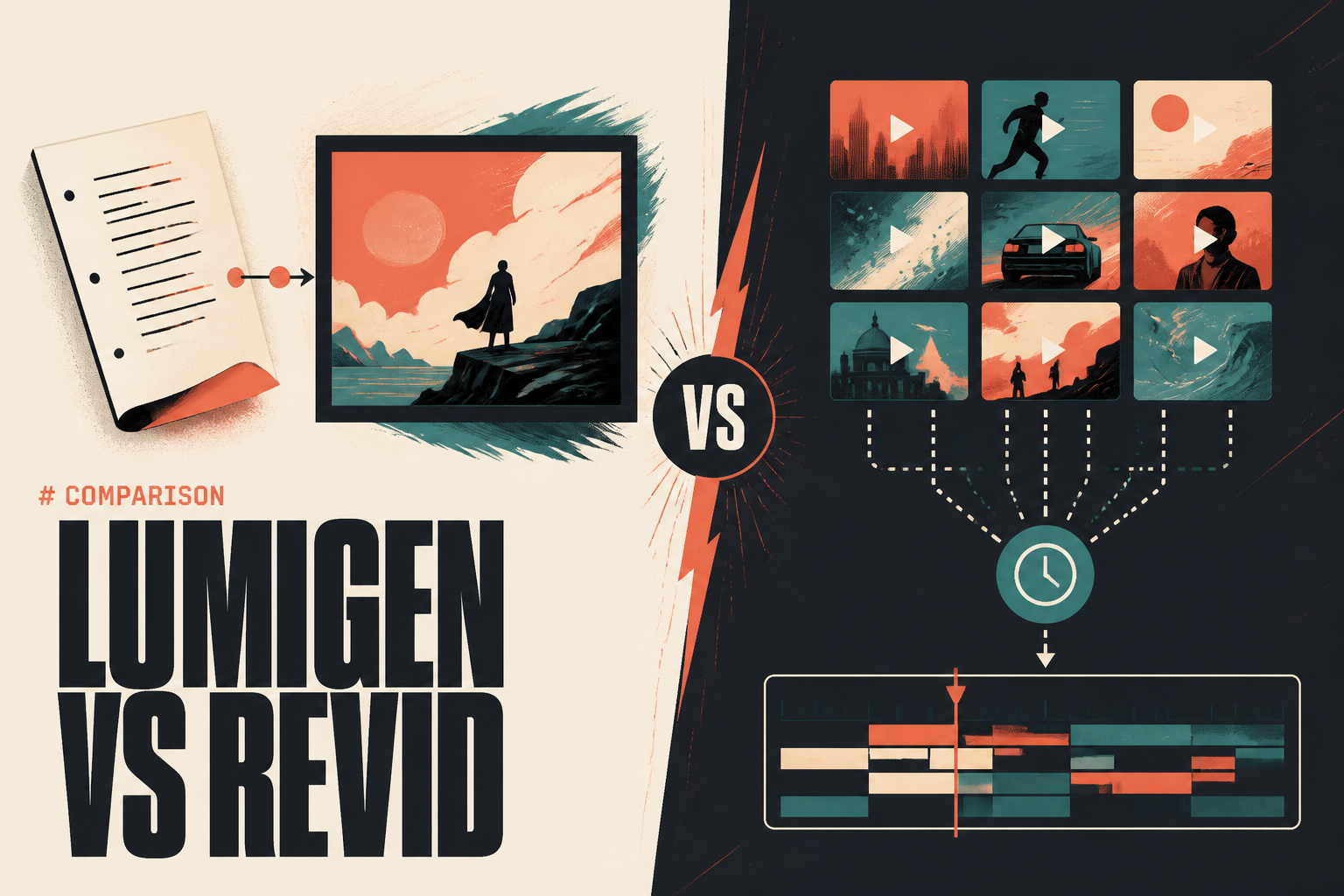
Lumigen and StoryShort both turn a text prompt into a finished video without a camera, but they are built for different jobs. Lumigen generates original footage from your script and routes to frontier video models, so the output looks made rather than assembled, and you pay per credit with the cost shown before you generate. StoryShort runs a hands-off faceless pipeline, script, AI images, voiceover, captions, and scheduled auto-posting to TikTok and YouTube, sold in monthly video quotas. If your bottleneck is output quality and originality, Lumigen wins. If it is posting volume on autopilot, StoryShort has the edge. This comparison breaks both down across output, features, automation, models, and price, with current pricing from each tool's own page.
OpenAI shut the Sora consumer app on April 26, 2026, and the Sora 2 API closes September 24, 2026. Treat Veo 3.1 and Kling 3.0 as the forward-looking defaults for from-scratch generation. See Sora 2 vs Veo 3.1 vs Runway vs Kling for the migration breakdown.
Lumigen vs StoryShort at a glance
| Dimension | Lumigen | StoryShort |
|---|---|---|
| Core job | Original video generation from a script | Hands-off faceless pipeline with auto-posting |
| Output style | Generated scenes, avatars, frontier-model footage | AI images plus voiceover, slideshow-leaning |
| Auto-posting to TikTok/YouTube | Not built in | Yes, with scheduling |
| Frontier video models | Veo 3.1, Kling 3.0, Sora 2 Pro (Ultra) | No, image-based generation |
| Pricing model | Per credit, cost shown before you generate | Monthly video-count quotas |
| Entry price | $33/month (Starter, annual) | $39/month (Starter, annual) |
| Free trial | Free trial credits | No free trial |
The short version: StoryShort is a posting machine, Lumigen is a quality machine. The rest of this post is about which machine matches your actual bottleneck.
Output: original generation vs faceless slideshow
The biggest difference is what comes out the other end. StoryShort builds faceless videos by generating AI images and stitching them under a voiceover with captions, which is fast and effective for story, documentary, and ASMR-style shorts, but it leans toward a slideshow look that viewers increasingly recognize. Lumigen generates actual video scenes from your script and can route to frontier models, so motion and realism reach a level a stacked-image pipeline cannot.
For a faceless channel posting daily story content, StoryShort's look is often good enough. For a creator or brand whose videos compete on production quality, the difference is the whole game. This is why Lumigen positions around original generation: when the buyer needs video made from nothing rather than assembled from a library, the output gap decides it.
A concrete way to see it: imagine a 45-second "did you know" history short. StoryShort will pair each line of narration with a generated still and a slow pan, which reads fine in a fast scroll but flat on a paused frame. The same script run as generated video produces moving scenes that hold up when a viewer actually stops, the moment that decides watch-time and saves. If your niche rewards scroll-stopping motion rather than just steady uploads, that is the line that matters most.
Features and workflow
Both tools cover the faceless basics: AI script generation, voices from ElevenLabs and OpenAI, automatic captions, a music library, and multilingual support. StoryShort focuses tightly on that pipeline and does it cleanly, which is its strength, one job, few decisions.
Lumigen covers a wider surface. Beyond script-to-video, it includes AI avatars, UGC ad generation, an image generator for thumbnails, motion control for animating stills, short-form vertical export, and lip-sync correction, all in one workflow. If your work is only faceless story shorts, that breadth is more than you need. If you also run ads, talking-head content, or multi-format video, it means one tool instead of five.
Automation and publishing: StoryShort's real strength
This is where StoryShort genuinely wins, and it is worth being clear about. StoryShort lets you connect TikTok and YouTube accounts, set a schedule, and have generated videos publish automatically, the closest thing to a set-and-forget faceless channel. For a creator whose goal is consistent daily output with minimal touch, that built-in auto-posting is a real advantage.
Lumigen does not auto-post. It is a generation and editing tool: you make the video, then publish it yourself or through your own scheduler. If hands-off scheduling is the feature you cannot live without, StoryShort fits that job better, and you should weigh that honestly before switching. Lumigen's bet is that output quality and creative control matter more than automation for creators trying to stand out rather than just show up.
Models and output quality
StoryShort relies on image-generation models stitched into video, which keeps it fast and cheap but caps the ceiling. There is no frontier video model under the hood. Lumigen runs standard models (Runway, Hailuo, Grok, SeeDance) on Growth and frontier models (Veo 3.1, Kling 3.0, Sora 2 Pro before its September 2026 sunset) on Ultra. That is the difference between a competent faceless short and footage that looks deliberately produced.
What frontier models actually buy you is coherence: consistent subjects across a shot, believable motion, and far fewer of the warping and morphing artifacts that give cheaper pipelines away. An image-stitch tool can place a great-looking frame, but it cannot make that frame move convincingly, which is exactly where AI video still betrays itself to a careful viewer. If your channel lives or dies on looking better than the next faceless account, the model layer is the deciding factor, and it is the one capability a quota of cheap videos cannot make up for.
Pricing and value
Here is current pricing from each tool's own page. StoryShort sells monthly video quotas; Lumigen sells credits with the per-video cost shown before you generate.
| Plan | Lumigen | StoryShort |
|---|---|---|
| Entry | $33/month, 1,500 credits | $39/month, 40 videos, 1 series |
| Mid | $58/month, 3,500 credits | $69/month, 120 videos, 2 series |
| Higher | $166/month, 10,000 credits plus frontier models | $129/month, 240 videos, 3 series |
| Top | Enterprise, custom | $199/month, 500 videos, 4 series |
The models are different on purpose. StoryShort's video-count quota is easy to reason about if you post a fixed number of shorts a month. Lumigen's per-credit pricing shows the exact cost of each video before you commit, so a short cheap clip costs less than a long frontier-model render, and you are not paying for a quota you do not use. StoryShort also has no free trial and a no-refund policy per its own pricing page, while Lumigen gives free trial credits to test the workflow first. Note that StoryShort's higher tiers chase raw video volume; Lumigen's higher tier buys output quality through frontier-model access.
Where each tool falls short
Neither tool is the right answer for everyone. The honest constraints:
- Lumigen has no built-in auto-posting. If a hands-off scheduled faceless channel is your whole goal, StoryShort does that out of the box and Lumigen does not.
- Lumigen's frontier models are Ultra-only. Veo 3.1, Kling 3.0, and Sora 2 Pro sit on the $166/month tier; lower tiers get good output, not frontier output.
- StoryShort caps on quality. Image-stitched faceless video has a ceiling, and user reviews report generated audio or video coming out unusable a meaningful share of the time, which hurts the very posting consistency it sells.
- StoryShort has no free trial. You pay before you can test it, where Lumigen lets you start on trial credits.
Verdict: which should you pick?
Pick StoryShort if your single goal is a hands-off faceless channel that auto-posts a fixed number of story-style shorts a month, and slideshow-grade output is fine for your niche. Its scheduling and quota model are built exactly for that.
Pick Lumigen if output quality, original generation, and creative range matter, if you want frontier-model footage, avatars, and UGC ads alongside faceless shorts, and if you would rather see each video's cost up front than buy a quota. Use the other tool where it is genuinely stronger, StoryShort owns hands-off auto-posting. But if the question is "what is the fastest path from a script to a publish-ready video with the highest output quality?" start with Lumigen's script-to-video editor, compare the two directly on the Lumigen vs StoryShort page, or jump to pricing to match a plan to your volume.
Frequently asked questions
StoryShort is better if you want a hands-off channel that auto-posts on a schedule. Lumigen is better if you want higher output quality, original generated scenes, and frontier-model footage, and you are willing to publish manually. Match the choice to whether your bottleneck is posting consistency or output quality.
No. StoryShort includes built-in auto-posting and scheduling; Lumigen is a generation and editing tool, so you publish through your own workflow. If automated scheduling is essential, StoryShort fits that job better.
Lumigen's entry plan is $33/month versus StoryShort's $39/month, but the models differ: StoryShort sells monthly video quotas while Lumigen sells credits with the per-video cost shown before you generate. Lumigen also offers free trial credits; StoryShort has no free trial.
For story, documentary, and ASMR-style faceless shorts, often yes. It builds videos from AI images plus voiceover, which leans toward a slideshow look. For footage that competes on production quality, Lumigen's frontier-model generation reaches a higher ceiling.
Yes. Lumigen gives free trial credits so you can test the script-to-video workflow before subscribing. StoryShort, by contrast, has no free trial and a no-refund policy per its pricing page.
Related reads


Same prompt.
Four models.
One project.
Sora 2, Veo 3.1, Runway Gen-4, Kling 3.0 — side by side, with a free tier that's actually useful for evaluation. Three videos at full quality, no watermark, no minute cap.

Vlad
Founder of Lumigen. Has shipped tens of thousands of generations across Sora 2, Veo 3.1, Runway Gen-4, and Kling 3.0 — and edits everything published here against that hands-on test bed.