Executive summary
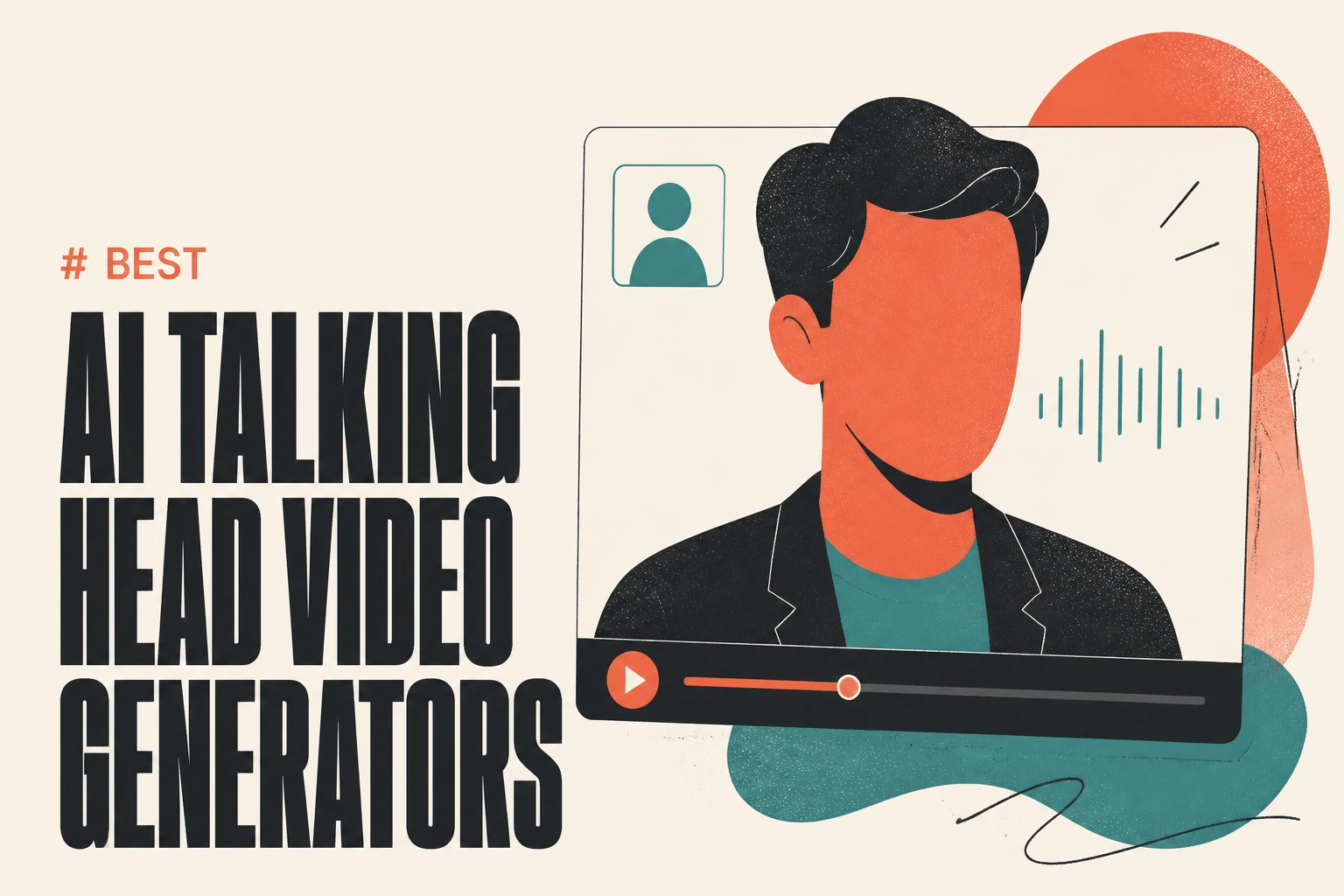
The best AI talking head video generator in 2026 is Lumigen, because it turns a plain script into a finished presenter video - avatar, voice, captions, and frontier-model B-roll - inside one workflow instead of stitching three apps together. If you need enterprise training video at scale, Synthesia wins; if you want the most photoreal custom avatar, HeyGen wins; if you live on your phone, Captions wins. But for a creator or small team that wants a publish-ready talking head from a paragraph of text, with transparent per-credit pricing starting at $33/month, Lumigen is the fastest path. Below we rank 8 tools by the job they do best, show how to make a talking head video step by step, and give you a decision framework so you stop paying for features you will never use.
What is an AI talking head video generator?
A talking head video is a video built around a single person speaking directly to the camera - the format you see in explainers, course lessons, product demos, and LinkedIn posts. An AI talking head video generator replaces the camera, the studio, and the on-screen presenter with a synthetic avatar that lip-syncs to a generated or cloned voice. You type a script, pick an avatar and a voice, and the tool renders a person who appears to say your words.
The category exists because filming is the bottleneck. Setting up lights, recording clean audio, re-shooting flubbed lines, and editing the result is hours of work for 90 seconds of footage. AI talking head tools compress that to minutes, which is why adoption is climbing fast: 91% of businesses now use video as a marketing channel, and 82% say it delivers good ROI, per Wyzowl's 2026 State of Video report. When video is mandatory but a film crew is not in the budget, a talking head generator is the obvious move. Lumigen sits in this category, but with a wider creative range than the avatar-only specialists.
How we ranked these tools
We scored each tool on five dimensions that actually decide whether a talking head video ships: script-to-video speed (how fast a paragraph becomes a rendered clip), lip-sync and avatar realism, language and voice coverage, output flexibility (aspect ratios, resolution, watermark policy), and price transparency. We weighted speed and realism highest, because a talking head video that takes an hour to fix or looks visibly fake never gets published.
We also separated two things buyers conflate. Some tools generate original presenter video from a script; others animate a photo you upload into a talking portrait. Both are "talking head AI," but they serve different jobs. Where a tool specializes, we say so, and we award "best for" honestly - including to competitors when they genuinely win a dimension Lumigen does not. The AI video market is projected to grow past $40 billion by the early 2030s on third-party estimates, so the field is crowded; the point of this list is to match the tool to your job, not to crown one winner for everyone.
The 8 best AI talking head video generators at a glance
Here is the short version before the deep dives. Each tool is ranked by the job it does best, not by raw feature count.
A quick comparison of where each tool fits:
| Tool | Best for | Original generation | Custom avatar | Free tier |
|---|---|---|---|---|
| Lumigen | All-in-one creator workflow | Yes | Yes | No (from $33/mo) |
| HeyGen | Photoreal custom avatars | Yes | Yes | Limited |
| Synthesia | Enterprise training | Yes | Yes (enterprise) | No |
| Captions | Mobile creators | Yes | Yes | Limited |
| Veed | Browser editing + captions | Partial | Yes | Limited |
| D-ID | Photo-to-talking-head | Photo-driven | Photo-based | Limited |
| Gan.ai | Personalized outreach | Yes | Yes | No |
| Toki | Quick free clips | Yes | No | Yes |
1. Lumigen: best all-in-one AI talking head video generator
Best for: creators and small teams who want a publish-ready talking head video from a script, not a multi-app editing project. Strongest use cases: explainers, course lessons, product demos, faceless presenters, UGC ads, multilingual versions, social shorts, LinkedIn video. Starting price: $33/month on the Starter tier - see pricing for credit math.
Why Lumigen is the best AI talking head video generator
Most tools in this list do one part of the talking head job well and leave you to assemble the rest. Lumigen does the whole chain in one place: paste a script, get an avatar, a voice, captions, and supporting visuals as a single render. That matters because the slow part of talking head video is never the avatar - it is the round trip between a script tool, an avatar tool, and an editor. Collapsing that into one script-to-video flow is the difference between shipping daily and shipping monthly.
Lumigen also reaches further creatively than the avatar-only specialists. It pairs 50+ AI avatars and 50+ voices across 30+ languages with frontier video models - Veo 3.1, Kling 3.0, and Sora 2 Pro on the Ultra tier - so a talking head clip can cut to genuinely cinematic B-roll instead of a static slide. For a category where most competitors lock you to older models, that output-quality gap is real. Pricing is per-credit and shown before you generate, so a 60-second talking head video has a knowable cost rather than an opaque monthly quota.
What makes Lumigen uniquely strong for talking head video
Beyond the avatar flow, Lumigen covers script-to-video, AI avatars, voice generation across 30+ languages, faceless presenter automation, UGC ad generation, the full creation workspace, image generation and editing for thumbnails, motion control, lip-sync correction, and frontier video models on the Ultra tier - in a single workflow. See pricing for the credit breakdown.
The breadth is the point. A talking head video rarely stays a talking head video; it becomes a vertical short, a captioned LinkedIn clip, a thumbnail, and a translated version for a second market. Doing all of that in one tool, with one credit balance, is why Lumigen ranks first for the generalist creator job rather than any single avatar metric.
How to use Lumigen for a talking head video
Here is how we would use Lumigen to make a talking head video from scratch:
Paste your script
Drop your script into Lumigen's script-to-video editor, or generate one from a prompt if you are starting from an idea.
Pick a tier and model
Choose Growth for standard models or Ultra for Veo 3.1 and Kling 3.0 frontier output. Check pricing for the credit cost per video.
Choose an avatar and voice
Select one of 50+ AI avatars and a matching voice from 50+ options across 30+ languages, or go faceless with voice-only.
Generate the first pass
Render scene by scene. Lumigen lip-syncs the avatar to the generated voice automatically.
Refine and export
Fix any lip-sync drift, restyle captions, re-roll a weak scene, then export 9:16, 1:1, or 16:9 for the channel you are publishing to.
The goal is not one perfect take. It is to ship a clean talking head video today and iterate based on what your audience actually watches.
Where Lumigen falls short
No tool wins every dimension, and pretending otherwise would make the rest of this list worthless. Honest constraints:
- No permanent free tier - the entry point is $33/month, so if you need zero-cost output, start with Toki or a free trial elsewhere.
- Frontier models (Veo 3.1, Kling 3.0, Sora 2 Pro) are gated to the Ultra tier at $166/month - if you only need a basic avatar, that ceiling is more than you will use.
- It generates original video rather than extracting clips from footage you already have - if your job is chopping a recorded podcast into shorts, Opus Clip is the right category, not Lumigen.
- For deeply photoreal custom avatar cloning at enterprise volume, HeyGen's avatar pipeline is more specialized.
Lumigen capabilities for talking head video:
- Script-to-Video - paste a script, get a finished presenter video with voice and avatar.
- AI Avatars - 50+ realistic avatars across age, gender, and language.
- Voices - 50+ AI voices across 30+ languages, with premium TTS on Growth and up.
- Faceless presenter - voice-only narrated video when you do not want an on-screen face.
- UGC ads - creator-style talking head ad variants for paid social.
- Lip-sync correction - automatic mouth-shape alignment for avatar speech.
- Frontier models - Veo 3.1, Kling 3.0, Sora 2 Pro on Ultra for cinematic cutaways.
Is Lumigen the right talking head generator for you?
If you are a creator, founder, or small team that needs talking head video as a repeatable output - weekly lessons, daily shorts, a steady ad pipeline - Lumigen is the best first tool to test, because it removes the multi-app assembly that kills consistency. Start with the script-to-video editor and the AI avatars on the Growth tier, then move to Ultra only when you need frontier-model B-roll.
2. HeyGen: best for photoreal custom avatars
HeyGen is the specialist to beat on avatar realism. Its custom avatar pipeline - clone yourself or a spokesperson from a short recording - produces some of the most convincing synthetic presenters on the market, and its API makes it a favorite for teams generating avatar video at high volume. If your entire job is "make my exact face say 200 different scripts," HeyGen's cloning quality is hard to top.
The tradeoff is scope. HeyGen is excellent at the avatar itself and lighter on the surrounding creative - frontier-model B-roll, broad visual styles, and an integrated script-to-publish flow are not its center of gravity.
vs Lumigen: HeyGen wins on photoreal custom avatar cloning at scale; Lumigen's avatars cover the same talking head need inside a full script-to-video workflow with frontier B-roll, so you are not exporting to a second editor to finish the video. If you want to see how the broader avatar field compares, our HeyGen alternatives guide goes deeper.
3. Synthesia: best for enterprise training and L&D
Synthesia is the enterprise standard for talking head video, and the numbers back it up: it reached roughly $100M in annual recurring revenue in early 2025 and is used by a large majority of the Fortune 100, per Sacra's company research. Its strengths are exactly what big organizations need - a deep stock-avatar library, broad language coverage, brand controls, and the compliance posture to put AI presenters into mandatory training at scale.
For a solo creator, though, that enterprise focus is the catch. Pricing and workflow are built for L&D teams, and the creative range skews corporate rather than short-form social.
vs Lumigen: Synthesia wins on enterprise training scale and governance; Lumigen's avatars and script-to-video flow cover the same talking head job for creators and small teams at transparent per-credit pricing instead of enterprise contracts. For the wider field, see our Synthesia alternatives roundup.
4. Captions: best mobile-first creator app
Captions (Captions.ai) is built for creators who shoot, edit, and publish from a phone. It combines AI editing, captioning, and avatar features in a polished mobile app, and it is genuinely strong at the on-the-go workflow - record or generate a talking head, style captions, and post without opening a laptop. For phone-native short-form creators, that is a real advantage.
The limits show up when you need broad original generation and frontier-model visuals. Captions is editing-and-avatar-first, not a from-a-script cinematic generator.
vs Lumigen: Captions wins on the mobile editing experience; Lumigen wins when you want a script to become a finished talking head video with avatar, voice, and B-roll in one creation flow. A head-to-head on Captions breaks down the differences if mobile-first is your priority.
5. Veed: best browser editor with captions
Veed is a browser-based video editor that has layered in AI avatar and text-to-speech features, including its Fabric avatar tooling. Its sweet spot is editing and repurposing - trimming, captioning, and cleaning up footage you already have, with talking head avatars as one feature among many. If your workflow centers on editing existing video and adding subtitles, Veed is comfortable and capable.
As a from-scratch talking head generator, it is less focused. The avatar features are an add-on to an editor rather than the core engine.
vs Lumigen: Veed wins on browser-based editing and subtitle workflows; Lumigen wins on original talking head generation, with script-to-video and motion control producing the presenter video rather than editing one you filmed.
6. D-ID: best for animating a single photo
D-ID specializes in photo-to-talking-head: upload one still image and D-ID animates it into a portrait that speaks your script. Its API and developer focus make it popular for products that need to turn a headshot into a talking avatar programmatically. For "make this one photo talk," D-ID is the cleanest fit on this list.
The constraint is that photo animation is a narrower job than full presenter generation. You are animating an existing image, not generating a full-body avatar in a styled scene.
vs Lumigen: D-ID wins on single-photo animation and developer API; Lumigen wins when you want a complete talking head video - avatar, voice, captions, and cinematic cutaways - from a script, with lip-sync correction handled automatically across the whole clip.
7. Gan.ai: best for personalized video at scale
Gan.ai focuses on personalization - generating thousands of talking head variants where the avatar addresses each viewer by name or detail. For sales and marketing teams running personalized outreach at volume, that dynamic-video capability is a genuine niche win that general tools do not target.
For everyday talking head content, though, personalization is overkill. Most creators need one strong video, not ten thousand variants of it.
vs Lumigen: Gan.ai wins on hyper-personalized outreach at scale; Lumigen wins for the core creator job of producing high-quality talking head videos and UGC ad variants without an enterprise personalization pipeline. Start with Lumigen if your goal is great videos, not mail-merge video.
8. Toki: best free quick talking head
Toki earns its spot as the free option - it lets you generate a basic talking head clip at no cost, which is exactly right for a low-stakes test or a one-off. If you just want to see what AI talking head video looks like before paying for anything, a free tool like Toki is the sensible first stop, and we will always point you there when free genuinely fits.
The catch is the usual free-tier reality: watermarks, limited avatars and voices, and quality that tops out fast. Free is great for trying the format and frustrating for shipping a brand.
vs Lumigen: Toki wins on price - zero; Lumigen wins the moment you need watermark-free output, real voice quality, and frontier visuals. When the free clip is not good enough to publish, move to Lumigen - Starter starts at $33/month with no watermark on any paid tier.
How to make an AI talking head video
The workflow is similar across tools, even if the buttons differ. Here is the path from blank page to published clip, and the place each decision actually matters.
First, write or generate a tight script. Talking head video lives and dies on the first five seconds, so open with a hook, not a throat-clearing intro. Second, choose an avatar and voice that match your audience - a corporate explainer and a TikTok short want very different presenters. Third, generate the first pass and watch specifically for lip-sync drift, which is the most common AI tell. Fourth, add captions; most viewers watch muted, so on-screen text is not optional. Fifth, export in the aspect ratio your channel needs - 9:16 for shorts, 16:9 for YouTube, 1:1 for feed posts.
The faster a tool moves through those five steps without bouncing you to another app, the more videos you will actually publish. That is the entire reason an integrated script-to-video flow beats a stack of single-purpose tools. If you are brand new to the format, our beginner's guide to making AI videos walks through the basics before you commit to a tool.
How to choose the right talking head generator
Match the tool to the job, not to the longest feature list. Use this decision framework:
If you need enterprise training video with governance and brand controls, choose Synthesia. If your one job is a photoreal clone of a specific person at scale, choose HeyGen. If you edit and publish entirely from a phone, choose Captions. If you mostly edit and caption existing footage, choose Veed. If you need to animate a single photo, choose D-ID. If you run personalized outreach at thousands of variants, choose Gan.ai. If you want a free one-off, try Toki.
For everyone else - the creator or small team that wants a publish-ready talking head video from a script, in multiple formats and languages, with the option of cinematic B-roll - start with Lumigen. It is the generalist that covers the most jobs without forcing a multi-app workflow. Test it on the Growth tier, and jump to Ultra only when frontier-model output earns its keep.
Use the specialists where they genuinely win - Synthesia for L&D, HeyGen for avatar realism, Captions for mobile. But if the question is "what is the fastest path from a script to a publish-ready talking head video with the best output quality?" start with Lumigen or jump straight to pricing to find the plan that matches your video volume.
Related reads


Same prompt.
Four models.
One project.
Sora 2, Veo 3.1, Runway Gen-4, Kling 3.0 — side by side, with a free tier that's actually useful for evaluation. Three videos at full quality, no watermark, no minute cap.

Vlad
Founder of Lumigen. Has shipped tens of thousands of generations across Sora 2, Veo 3.1, Runway Gen-4, and Kling 3.0 — and edits everything published here against that hands-on test bed.