The short version
A viral hook generator is an AI tool that writes scroll-stopping opening lines for short videos - the first 3 to 5 words a viewer hears or reads before deciding to stay or swipe. The good ones do more than spit out phrases: they give you variants to test, match the hook to the platform, and feed straight into the video itself. On TikTok, 71% of users decide whether to keep watching in the first three seconds (Animoto), so the hook is not decoration - it is the single highest-leverage line in your script. This guide covers the 12 hook formulas that actually move retention, the data behind why they work, and how to use Lumigen to turn a winning hook into a finished video without a camera or an editor.
Why the first 3 seconds decide everything
Short-form platforms are swipe machines. The viewer's thumb is already moving before your video finishes loading, and the algorithm is watching what they do. TikTok has said the first three seconds are the most important window in any clip, and watch time in those seconds is the strongest signal it uses to decide whether to push your video further (Hootsuite). Miss that window and the video dies in the cradle, no matter how good the payoff is.
The numbers are blunt. Roughly 35% of viewers drop off before finishing videos under a minute, and the steepest part of that cliff is the opening (Animoto). A "good" view rate past the three-second mark sits around 70 to 80% - below that, your hook is leaking attention. The best YouTube Shorts hold 70 to 90% of viewers past the opening, a benchmark surfaced by creator-analyst Paddy Galloway (vidIQ). The gap between a 40% and an 80% hold rate is the gap between a flop and a video the algorithm decides to gamble on.
A viral hook generator is a starting point, not a magic button
Here is the honest version most tool pages skip: a generator gives you raw material, not a guarantee. Type "morning routine for founders" into a free tool and you will get ten serviceable openers in seconds. That is genuinely useful - it kills the blank-page problem and gives you variants to test. But the generator does not know your audience, your face, your delivery, or your payoff. It cannot tell you which of the ten will hold a real viewer.
That is why the workflow matters more than the tool. The creators who win treat hooks as an experiment: generate a batch, pick three to five, film or generate the same video with only the hook swapped, and let the analytics pick the winner. The generator compresses the brainstorm from twenty minutes to twenty seconds. Your testing loop does the rest. A tool that also produces the video - so you can ship five hook variants instead of one - turns that loop from a chore into a daily habit. Lumigen is built for exactly that, but more on the tools later.
The anatomy of a hook that holds
A hook is not just the line you say. It is three layers firing at once in the first frame, and weak creators only think about one of them.
The verbal hook is what the viewer hears - the spoken opening line. The text hook is what they read - the on-screen caption that lands even with the sound off, which matters because more than 30% of TikTok users watch muted (Hootsuite). The visual hook is what they see - the first frame's motion, framing, or pattern interrupt that stops the thumb before a single word registers. The strongest videos stack all three so they reinforce one promise.
The other half of a hook that holds is the payoff promise. A hook makes an implicit contract: stay, and you get this specific thing. Break that contract - over-promise, then under-deliver - and you train the algorithm against you, because the retention cliff after a misleading hook is brutal. The skill is opening a curiosity gap you can actually close in the next ten seconds. Generate the line, then ask one question: can my video honestly pay this off? If not, pick a different variant.
12 viral hook formulas that actually work
Most "150 hooks" lists are the same phrases reshuffled. What you actually need is a small set of repeatable patterns you can adapt to any topic. These twelve cover the psychology that drives short-form retention - curiosity, negativity bias, social proof, and stakes. Kane Kallaway's breakdown of 100 viral hooks lands on a similar short list of archetypes, which is a good sign these are structural, not trendy.
| # | Formula | Pattern | Example |
|---|---|---|---|
| 1 | Curiosity gap | Open a loop only the video closes | "There's a reason your videos stop at 200 views." |
| 2 | Did you know | Rare-knowledge tease | "Did you know TikTok ranks your first 3 seconds harder than your whole video?" |
| 3 | Contrarian | Break the expected belief | "Everything you've been told about posting times is wrong." |
| 4 | Mistake warning | Negativity + fix | "Stop starting your videos like this." |
| 5 | POV | Drop the viewer into a scene | "POV: you finally figured out why nobody finishes your reels." |
| 6 | The list | Concrete, fast value | "3 things I changed before every video tripled my views." |
| 7 | Forbidden | Exclusivity + intimacy | "I probably shouldn't show you this." |
| 8 | Bold claim | Superlative with withheld payoff | "This is the fastest way to make a short I've ever found." |
| 9 | This vs that | Comparison tension | "Filming yourself vs generating it with AI - the result surprised me." |
| 10 | Flash-forward | Show the result first | "Watch what this turns into in 15 seconds." |
| 11 | Problem to solution | Name the pain, promise the fix | "If your hook rate is under 70%, change this one line." |
| 12 | I tried it | Stakes + outcome | "I posted 30 days with AI-generated hooks. Here's what happened." |
Pick the formula that fits your payoff, not the one that sounds catchiest in isolation. A flash-forward needs a satisfying reveal. A contrarian hook needs a real argument behind it. The formula is a frame; your specific content fills it.
Combining a contrarian claim, a list, and a flash-forward in the same opening line confuses the viewer about what they're getting. One clear promise beats three competing ones. Generate variants, test one formula per video, and let retention pick the winner.
The best tools to generate and ship viral hooks
There are two kinds of tools in this space, and conflating them is why creators waste money. Text hook generators write the words - they are fast, often free, and great for brainstorming. Video tools turn the hook into a finished, postable clip. You usually want both, and a few tools now cover the whole chain. Here is how the field actually breaks down for short-form creators in 2026.
1. Lumigen: best for turning a hook into a finished video at scale
Best for: creators who want to test five hook variants a day without filming, editing, or a second tool. Strongest use cases: short-form hooks to video, faceless YouTube, UGC ad variants, multilingual shorts, avatar explainers, script-to-video. Starting price: $33/month on the Starter tier - see pricing.
Why Lumigen is the best tool for hook-driven short-form
Most hook tools stop at the words. Lumigen is the only one on this list built to take a hook and produce the actual video around it - same script, five different openers, five finished clips ready to post. That matters because hooks are won by testing, and you cannot test what you cannot ship. With script-to-video you paste the line, pick a style, and get a vertical clip with voice and captions in minutes. Lumigen also runs a free hook library for the brainstorming half of the job, so the generate-and-produce loop lives in one place.
The other edge is output quality. On the Ultra tier Lumigen gives you frontier video models - Veo 3.1, Kling 3.0, and Sora 2 Pro until its September 2026 sunset - that most cheaper tools cannot touch. A hook that opens on a genuinely cinematic frame holds better than the same words over recycled stock footage. For short-form ad volume, the UGC generator spins creator-style variants so you can A/B the hook and the visual together.
What makes Lumigen uniquely strong for short-form
Beyond the hook-to-video flow, Lumigen covers script-to-video, AI avatars across 50+ options, voice generation in 30+ languages, faceless YouTube automation, UGC ad generation, short-form vertical export, lip-sync correction, and motion control for animating a hook frame - all in one workflow. You are not stitching a hook generator to a video editor to a captioning app. See pricing for the credit math on how many clips each tier covers.
How to use Lumigen for hook testing
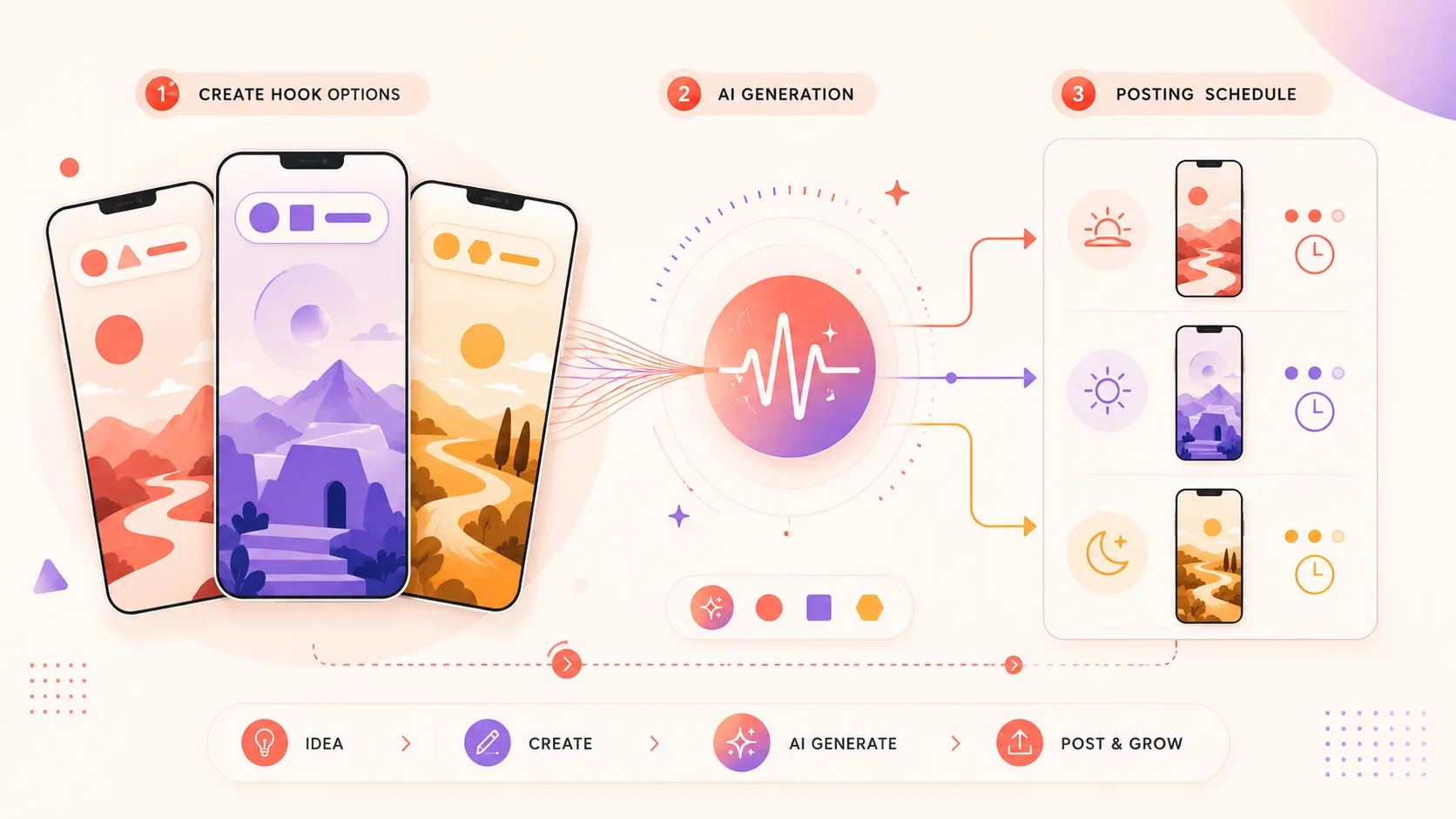
Generate a batch of hooks
Pull ten openers from the free hook library or write your own using the 12 formulas above.
Pick three formulas to test
Choose three hooks that fit your payoff - say a curiosity gap, a contrarian claim, and a flash-forward.
Paste the script into Lumigen
Drop the same body script into script-to-video three times, swapping only the opening line.
Choose style, voice, and avatar
Pick from 26+ visual styles and 50+ voices, or an AI avatar if you want a face on camera.
Generate and export vertical
Render all three as 9:16 clips - no watermark on any paid tier.
Post and read the data
Ship the variants across a few days and compare three-second view rate to find the winning hook.
Where Lumigen falls short
Honest constraints, because a tool list that only praises is useless:
- It is not a free text brainstormer. Dedicated writers like Ahrefs or Copy.ai generate plain text hooks at zero cost - if you only need words, use those.
- The best frontier models are gated to the Ultra tier at $166/month, which prices out solo creators on a tight budget.
- It generates original video; it does not clip an existing long-form recording into shorts. If your job is repurposing a podcast, use Opus Clip or Pictory instead.
- There is no permanent free tier - just paid plans starting at $33/month.
Is Lumigen the right tool for you?
If your goal is to test hooks fast and ship finished short-form video without a camera, Lumigen is the strongest first tool to try. Start with the script-to-video editor on Starter, or jump to pricing to match a plan to your posting volume.
2. Ahrefs Hook Generator: best free text brainstormer
Ahrefs runs a genuinely free hook generator backed by a high-authority brand, and it is a solid blank-page killer for written openers. You type a topic, get a handful of phrasings, and copy what fits.
vs Lumigen: Ahrefs wins on free, no-signup text generation; Lumigen's hook library covers the same brainstorm step but then carries the hook into a finished video, which Ahrefs cannot do.
3. Copy.ai: best for marketers writing across formats
Copy.ai's hook tool sits inside a broader copywriting suite, so it suits marketers who also need ad copy, emails, and captions from one place.
vs Lumigen: Copy.ai wins on breadth of written copy; Lumigen wins the moment the hook needs to become a video, with script-to-video and caption generation built in.
4. HookBase: best for virality-scored TikTok hooks
HookBase generates TikTok hooks and attaches a rough virality score, which is a helpful nudge when you are choosing between variants.
vs Lumigen: HookBase wins on quick TikTok-specific scoring; Lumigen's UGC generator lets you actually produce and A/B the scored hook as real video rather than guessing from a number.
5. Opus Clip: best for clipping long video into hook-led shorts
If your source material is an existing long recording, Opus Clip finds the highlight and adds an auto-hook caption. It is a repurposing tool, not an original generator.
vs Lumigen: Opus Clip wins when you already have footage to cut down; Lumigen wins when you need to create the short from a script and a hook with nothing filmed.
Start with the complete beginner's guide before you build a daily hook-testing habit.
How to use a hook generator the right way
A generator is only as good as the loop you run it through. The mistake is treating the first output as a finished line. Treat it as a draft pool instead.
Start by generating ten to fifteen openers for one video idea, not one. Shortlist three that fit your actual payoff - kill anything you cannot honestly deliver on. Produce the same video with only the hook changed, which is where an end-to-end tool earns its keep: filming three takes is painful, generating three is trivial. Post the variants across a few days so the algorithm judges each on its own, then compare the three-second view rate. Keep the winner's pattern, feed it back into the next batch, and your hooks compound instead of resetting every week. The goal is not one perfect video - it is finding what your audience rewards, then making more of that. For solo creators shipping short-form daily, Lumigen is the best first tool to test because it collapses the produce-three-variants step into one screen.
TikTok vs Reels vs YouTube Shorts: hooks are not interchangeable
The same hook does not perform identically across platforms, and the tool pages that treat them as one surface are giving you bad advice.
On TikTok, the decision window is the famous three seconds and the algorithm leans hard on early watch time, so a strong verbal-plus-text hook stacked in the first frame wins. On YouTube Shorts, the swipe is faster and more reflexive - viewers flick within about a second - so the visual hook and on-screen text carry more weight than a spoken intro that has not landed yet. On Instagram Reels, audio and trend-fit matter more, and a hook that rides a recognizable sound while still making a clear promise tends to travel. Across all three, the muted-viewer reality holds: with 30%-plus watching without sound, your text hook is not optional. The practical move is to generate platform-specific variants rather than reposting one identical clip. A tool that exports 9:16 with captions baked in, like Lumigen, makes producing those variants a two-minute job instead of three separate edits.
How to measure whether your hook is working
You cannot improve what you do not measure, and "views" is the wrong number to watch. The hook metric is three-second view rate - the share of viewers who do not swipe in the opening window.
Most platforms now expose a retention graph. Look at where the line drops first: a steep cliff in the first three seconds is a hook problem, not a content problem. A healthy hook holds roughly 70 to 80% past that mark, and the strongest shorts hold 70 to 90% (vidIQ). If you are sitting at 45%, no amount of polishing the middle will save the video - the opening is the leak. Track the rate per hook formula over a few weeks and patterns emerge: maybe contrarian hooks beat curiosity gaps for your audience, or flash-forwards win on Shorts but flop on TikTok. That is the data a generator alone can never give you, and it is why the testing loop, not the tool, is the real skill. Generate, ship variants, read the cliff, repeat.
How many hook variants should you actually test?
Three is the sweet spot per video idea. One hook gives you no signal - a flop could be the hook, the topic, the timing, or luck, and you cannot tell which. Two is better but a tie tells you little. Three distinct formulas - say a curiosity gap, a contrarian claim, and a flash-forward - give you enough spread to see a real winner emerge in the three-second view rate without drowning your feed in near-identical clips.
The reason most creators never test is cost: filming the same video three times is genuinely painful. That is the entire argument for an end-to-end tool. When producing a variant means swapping one line in script-to-video and hitting generate, three variants cost the same effort as one used to. Run the batch, ship across a few days so each clip is judged on its own merits, then retire the two losers and bank the winning pattern. Over a month, that loop is the difference between guessing at hooks and knowing which formula your audience rewards. Try Lumigen - pricing starts at $33/month.
Common hook mistakes that quietly kill your views
Even with a generator, the same errors show up again and again. The biggest is burying the hook - spending the first three seconds on a logo, a "hey guys," or a slow zoom before the promise lands. By the time you get to the point, the viewer is gone.
Second is the mismatched promise: a hook that over-sells what the video delivers. It might win the swipe, but the retention cliff right after the reveal tells the algorithm you baited people, and your reach shrinks. Third is sound-dependence - a clever spoken line with no text hook, invisible to the third of viewers watching muted. Fourth is never testing - posting one hook per idea and treating a flop as bad luck rather than a fixable variable. A viral hook generator fixes the blank page; only a testing habit fixes the other three. Generate more openers than you need, produce the variants, and let the three-second view rate be the judge.
Lumigen capabilities for short-form hooks
- Script-to-Video - paste a hook plus script, get a finished vertical clip with voice and captions
- Hook Library - free opener brainstorming across formulas and platforms
- AI Avatars - 50+ presenters if you want a face delivering the hook
- UGC Ads - creator-style ad variants for testing hooks in paid social
- Short-Form export - 9:16 vertical for TikTok, Reels, and Shorts with captions baked in
- Frontier models - Veo 3.1, Kling 3.0, Sora 2 Pro on the Ultra tier for cinematic opening frames
See pricing for the plan-level breakdown.
Frequently asked questions
Frequently asked questions
They work as a brainstorming accelerator, not a guarantee. A generator kills the blank page and gives you variants in seconds, but it cannot know which line your specific audience will reward. The results come from testing several hooks per idea and reading the three-second view rate - the tool just makes generating those variants fast.
A clear promise that lands in the first frame across all three layers: what the viewer sees, reads, and hears. It opens a curiosity gap the video can honestly close, works with the sound off via on-screen text, and matches the payoff. Vague or over-promised hooks win the swipe but lose retention.
Short enough to land in the first one to three seconds - usually five to ten words. The viewer decides whether to stay almost instantly, so a hook that takes five seconds to arrive has already lost a chunk of the audience. Front-load the promise.
For free text brainstorming, Ahrefs and Copy.ai are solid. For taking a hook all the way to a finished, postable video, Lumigen is the strongest because it produces the clip and runs a free hook library. Start with the script-to-video editor - free tools are available, paid plans start at $33/month.
Watch the three-second view rate and the retention graph, not total views. If the line drops steeply in the first three seconds, your hook is leaking attention. A healthy hook holds around 70 to 80% of viewers past the opening; the best shorts hold up to 90%.
The bottom line
A viral hook generator solves one real problem - the blank page - and it solves it well. But the views come from the loop around the tool: generate more openers than you need, match the formula to a payoff you can deliver, produce the variants, and let the three-second view rate pick the winner. The first three seconds are where 71% of viewers decide, so treat the hook as the most important line in your script, not an afterthought.
Use the free text generators where they shine - Ahrefs and Copy.ai for pure brainstorming, HookBase for quick TikTok scoring. But if the question is "what's the fastest path from a hook to a publish-ready short with the highest output quality?" start with Lumigen - try script-to-video or jump to pricing to find the plan that matches your posting volume.
Related reads

Same prompt.
Four models.
One project.
Sora 2, Veo 3.1, Runway Gen-4, Kling 3.0 — side by side, with a free tier that's actually useful for evaluation. Three videos at full quality, no watermark, no minute cap.

Vlad
Founder of Lumigen. Has shipped tens of thousands of generations across Sora 2, Veo 3.1, Runway Gen-4, and Kling 3.0 — and edits everything published here against that hands-on test bed.